
- 24 Nov 2026
How to Plan LED Inground Lighting for Large Commercial Projects
How to Plan LED Inground Lighting for Large Commercial Outdoor Projects
Planning LED inground lighting for a large commercial outdoor project requires more than selecting fixtures and placing them along a walkway. Shopping malls, commercial plazas, retail complexes and public landscapes often contain hundreds of recessed ground lights across different lighting zones.
For lighting contractors, landscape designers and commercial property developers, the main challenge is achieving a consistent lighting effect while keeping installation and maintenance practical.
A successful commercial LED inground lighting plan should consider four key factors:
Fixture spacing and lighting layout
Illumination uniformity and glare control
Color temperature consistency across bulk orders
Maintenance access and long-term replacement
This guide explains how to plan LED inground lighting for large commercial outdoor projects, from the initial site survey to final installation and maintenance.
Related Application:Commercial LED Inground Lighting
1. Start with a Lighting Layout for the Entire Commercial Site
Before selecting LED inground lights, divide the project into different functional lighting zones.
A shopping mall or commercial plaza may include:
Main building entrances
Outdoor pedestrian walkways
Landscape trees and planting areas
Architectural columns and walls
Open plazas and decorative paving
Parking areas and vehicle-accessible zones
Each area has different lighting requirements. A tree uplighting layout may focus on visual accents, while a pedestrian walkway needs more attention to visibility, glare and the relationship between decorative lighting and functional lighting.
Create a Fixture Layout Before Ordering
A preliminary lighting layout should show:
Site dimensions and paving boundaries
Fixture positions and installation direction
Target objects and illuminated areas
Proposed beam angles and wattages
Cable routes and power supply locations
Drainage and maintenance access points
For large projects, a scaled drawing helps the contractor estimate fixture quantities and identify potential installation problems before construction begins.
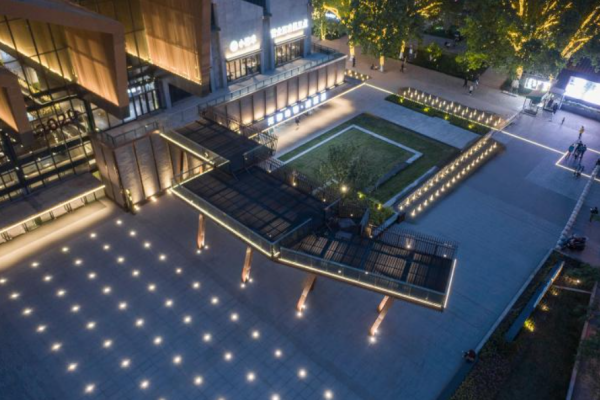
2. How to Plan LED Inground Light Spacing
LED inground light spacing is one of the most important factors affecting the final lighting appearance.
If fixtures are installed too far apart, the illuminated areas may appear disconnected, creating dark gaps between light beams. If fixtures are placed too close together, overlapping beams can produce bright hotspots and unnecessary installation costs.
There is no universal spacing distance for all LED inground lights. The correct spacing depends on the fixture's optical distribution, installation position, mounting depth, target height and desired lighting effect.
Step 1: Identify the Target Area
First, determine what the fixture is intended to illuminate.
For example:
A tree trunk requires a different layout from a broad tree canopy.
A narrow column may need focused lighting from one or more positions.
A walkway edge may require a repeated linear arrangement.
A plaza feature may need several fixtures from different directions.
The target object and desired effect should determine the layout, rather than choosing a spacing distance first.
Step 2: Consider Beam Angle and Installation Distance
Beam angle affects the approximate size of the illuminated area.
For a fixture aimed vertically at a flat surface, a simplified beam-footprint estimate is:
Beam diameter ≈ 2 × distance × tan(beam angle ÷ 2)
For example, a wider beam generally produces a larger illuminated footprint at the same distance.
However, this calculation is only a preliminary geometric estimate. It does not account for the fixture's actual intensity distribution, beam shape, aiming angle, surface reflectance or the brightness required at the target.
For angled tree uplighting and architectural accents, the illuminated footprint may be elongated or asymmetrical. Therefore, the beam diameter should not be treated as the actual recommended fixture spacing.
Related Blog: LED Inground Light Beam Angle
Step 3: Plan Beam Overlap
For repeated fixtures along a walkway or landscape border, review how adjacent light distributions overlap.
A practical planning process is:
Mark the proposed fixture positions on the site plan.
Select the preliminary beam angle and output.
Review the manufacturer's photometric data.
Check the illuminated footprint between adjacent fixtures.
Adjust spacing or optical distribution if dark gaps or excessive hotspots appear.
For large or complex commercial projects, use IES/LDT photometric files in lighting design software to evaluate the proposed layout before bulk purchasing.
Step 4: Confirm Spacing with a Sample Installation
A sample installation is particularly valuable when the project uses decorative inground lights.
Install several fixtures at the proposed spacing and evaluate the lighting effect at night.
Check:
Whether the target objects are adequately illuminated.
Whether the light beams overlap as intended.
Whether dark gaps appear between fixtures.
Whether the fixtures create excessive glare.
Whether the proposed spacing matches the architectural design.
The sample layout should be approved before repeating the same installation across the entire commercial site.
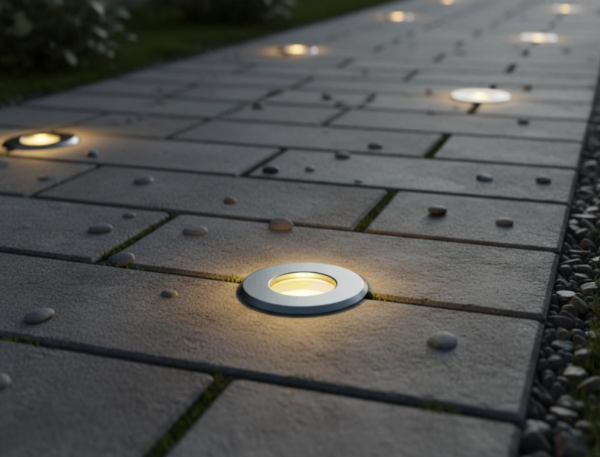
3. How to Achieve Uniform LED Inground Lighting
Lighting uniformity is important in large commercial outdoor projects because visitors often see multiple fixtures at the same time.
A lighting layout with strong hotspots and dark areas may look inconsistent, even when the average light output is sufficient.
Uniformity Is More Than Brightness
Uniformity describes how evenly light is distributed across a defined area.
For example, a walkway may have a bright spot directly above or beside a fixture but much lower illumination between fixtures. The average illuminance alone may not reveal this problem.
For functional pedestrian areas, designers should evaluate the required illuminance and uniformity according to the project's lighting criteria and applicable local standards.
For decorative landscape lighting, visual consistency should also be assessed from the main viewing positions.
Common Causes of Uneven Inground Lighting
Several factors can create uneven lighting:
Incorrect fixture spacing
Excessive spacing may create dark gaps, while very close spacing can create overlapping hotspots.
Unsuitable beam angle
A narrow beam may be too concentrated for a broad target. A wide beam may reduce the desired visual emphasis on a narrow architectural feature.
Different installation distances
Fixtures installed at different distances from the target may produce different brightness levels, even when they have the same wattage.
Inconsistent fixture output
Different LED configurations, optical components or production variations can affect the appearance of the lighting system.
Poor aiming and positioning
Small changes in fixture direction can significantly affect the appearance of tree uplighting and architectural accents.
Practical Ways to Improve Uniformity
For large commercial projects, consider the following measures:
Use the same fixture model and optical configuration within each lighting zone.
Maintain consistent installation distances where the design requires a repeated effect.
Confirm the beam angle before finalizing the fixture layout.
Avoid mixing different wattages without checking the overall visual balance.
Review the lighting effect from pedestrian viewing positions.
Use photometric calculations for areas where measurable uniformity is required.
For a commercial plaza, it is often better to create a controlled and balanced lighting effect than to simply increase the wattage of every fixture.
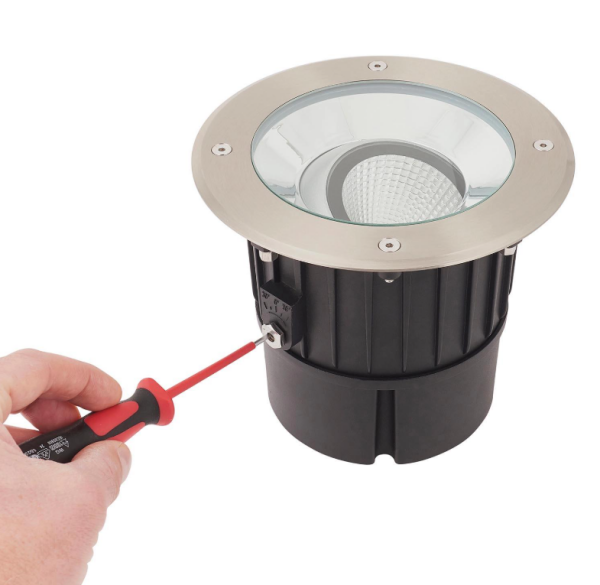
4. How to Maintain Consistent Color Temperature in Bulk Orders
Color temperature consistency is a major concern when purchasing LED inground lights in large quantities.
A commercial project may use dozens or hundreds of fixtures across entrances, landscape trees, columns and walkways. If the fixtures have visibly different color tones, the entire lighting design may appear inconsistent.
Choose the Color Temperature Before Bulk Production
Common outdoor lighting color temperatures include:
2700K: Warm appearance for selected landscape and hospitality environments.
3000K: Warm white commonly used for commercial landscape and architectural accents.
4000K: Neutral white for some contemporary commercial and functional outdoor applications.
The appropriate CCT depends on the architectural design, surrounding lighting, landscape materials and project specifications.
For a large commercial development, avoid selecting color temperature independently for each fixture. Establish the CCT for each lighting zone before ordering.
Confirm LED Color Binning
Nominally identical CCT values do not automatically guarantee that every fixture will look exactly the same.
For bulk purchasing, buyers should discuss the following with the manufacturer:
LED color binning and color consistency specifications.
The CCT tolerance available for the selected product.
Whether the order can be supplied from a consistent production specification.
Sample approval before mass production.
Procedures for matching replacement fixtures in future phases.
If a project uses 3000K LED inground lights, confirm the acceptable color variation rather than relying only on the number printed on the product specification sheet.
Choose the item: LED Inground Light
Approve Samples Before Ordering Hundreds of Fixtures
For commercial plaza and shopping mall projects, sample approval should be part of the procurement process.
Before mass production:
Confirm the selected CCT and beam angle.
Install sample fixtures in the intended environment.
Compare the appearance of multiple samples together.
Check the lighting effect against surrounding facade and landscape lighting.
Approve the specification for bulk production.
For phased projects, keep a record of the approved model, CCT, LED specification and optical configuration. This helps reduce color differences when additional fixtures are ordered later.
5. Design LED Inground Lighting for Easy Maintenance
Maintenance is often overlooked during the early lighting design stage.
However, commercial outdoor projects may have paved surfaces, landscaped areas, public walkways and restricted installation access. Replacing a failed inground light can become expensive if the fixture location or installation structure is difficult to access.
A maintenance-friendly design should consider the complete installation system, not just the luminaire itself.
Plan Access to the Fixture
Before installation, confirm how the fixture will be removed and replaced.
Consider:
Whether the fixture can be accessed without damaging surrounding paving.
Whether the installation uses a suitable recessed housing or mounting arrangement.
Whether cable connections can be reached safely.
Whether the fixture can be replaced without disturbing adjacent lights.
Whether the installation location allows sufficient working space.
For large projects, record fixture locations on the as-built drawing so maintenance teams can identify each lighting zone.
Consider Drainage and Water Management
LED inground lights are installed close to the ground and may be exposed to rainwater, irrigation and surface runoff.
A suitable installation plan should include:
Proper drainage around the fixture housing.
Protection of cable connections.
Correct installation of seals and cable entries.
Compliance with the manufacturer's installation instructions.
Avoidance of locations where water is likely to remain standing.
IP rating should be selected according to the actual installation environment. An IP67 rating does not automatically mean that a fixture is suitable for permanent underwater use.
Related Blog:IP67 LED Inground Light
Related Blog: Stainless Steel LED Inground Light
Related Blog:LED Inground Light Manufacturer
Confirm Mechanical Load Requirements
Commercial plazas may include pedestrian areas, service routes and vehicle-accessible zones.
Before selecting a fixture, identify whether the installation will be exposed to:
Pedestrian traffic
Cleaning equipment
Maintenance carts
Light service vehicles
Heavy vehicle traffic
The complete luminaire and installation structure must be suitable for the expected mechanical load.
Do not assume that every recessed LED inground light is suitable for vehicle traffic. Confirm the manufacturer's rated load capacity and installation requirements before specifying the product.
Reduce Maintenance Complexity Through Standardization
For large commercial developments, using too many different fixture models can increase maintenance complexity.
Where possible, standardize:
Fixture families
Wattage and optical configurations
Color temperature
Power supply specifications
Installation accessories
Replacement procedures
A standardized lighting system makes it easier for facility managers to maintain consistent appearance and manage replacement inventory.
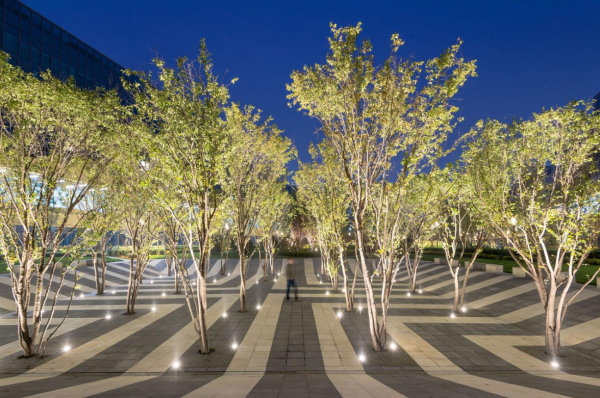
6. Commercial LED Inground Lighting Project Planning Checklist
Before confirming a bulk order, project buyers and lighting contractors should review the following checklist.
Lighting Design
Site plan and fixture positions are confirmed.
Lighting zones are clearly defined.
Beam angles are selected for each application.
Fixture spacing has been reviewed.
Uniformity and glare have been considered.
Photometric files are available where required.
Product Specification
Wattage and lumen output are confirmed.
CCT and color consistency requirements are agreed.
Input voltage is compatible with the project.
IP rating matches the installation environment.
Materials are suitable for the outdoor conditions.
Mechanical load requirements are confirmed.
Procurement and Installation
Samples are approved before bulk production.
Product specifications are standardized by zone.
Installation accessories are confirmed.
Drainage and cable routing are planned.
Maintenance access is included in the design.
Replacement fixture requirements are documented.
7. Why Work with an LED Inground Light Manufacturer for Large Projects?
For commercial outdoor lighting projects, working directly with an experienced manufacturer can help buyers confirm product specifications before placing a bulk order.
A project-oriented supplier should be able to support discussions about:
Suitable wattage and beam angle for different applications.
Product dimensions and installation requirements.
Available photometric files.
Color temperature and production consistency.
Sample approval and bulk order specifications.
Outdoor material and protection requirements.
Project quantity and delivery planning.
Always Lighting supports LED inground lighting enquiries for commercial outdoor applications, including shopping mall entrances, commercial plazas, landscape trees, architectural columns and public pedestrian areas.
For large projects, providing a site plan, application photos and estimated quantity helps the supplier recommend more suitable product configurations.
Request LED Inground Lighting Support for Your Commercial Project
Planning LED inground lighting for a shopping mall, commercial plaza or large outdoor development?
Contact Always Lighting with your project details to discuss product selection and bulk supply requirements.
To help us understand your project, please provide:
Project location and application.
Estimated fixture quantity.
Site plan or installation drawings.
Target objects and installation distances.
Preferred wattage, beam angle and CCT.
Required IP rating and mechanical load conditions.
Expected delivery schedule.
Send your commercial outdoor lighting requirements to Always Lighting to discuss suitable LED inground light configurations for your project.
Frequently Asked Questions
1. How far apart should LED inground lights be installed?
There is no universal spacing distance. Spacing depends on beam angle, fixture output, installation distance, target size and the desired lighting effect. A sample installation or photometric review can help confirm the layout.
2. How can I avoid dark spots between LED inground lights?
Review fixture spacing, beam distribution, installation distance and aiming direction. For large projects, use photometric files to evaluate the proposed layout before installation.
3. How do I keep the color temperature consistent in a bulk LED inground light order?
Confirm the CCT, LED color binning and acceptable color variation with the manufacturer. Approve samples before mass production and keep the same specification for each lighting zone.
4. Should all LED inground lights in a commercial project use the same wattage?
Not necessarily. Different applications may require different output levels. However, fixtures within the same lighting zone should have compatible specifications to maintain a consistent appearance.
5. How can LED inground lights be easier to maintain?
Plan fixture access, drainage, cable protection and replacement procedures before installation. Standardizing fixture models and recording fixture locations can also simplify maintenance.
6. Are LED inground lights suitable for commercial pedestrian walkways?
They can be used as decorative or supplementary lighting when selected and installed appropriately. The complete lighting design should still meet the project's functional visibility, glare and accessibility requirements.
7. What information should I provide when requesting a commercial LED inground lighting quotation?
Provide the project location, application areas, estimated quantity, site plan, preferred CCT, beam angle, wattage, input voltage, IP rating, mechanical load requirements and delivery schedule.
Contact us : Always lighting