
- 02 Nov 2026
12V vs 24V vs 220V LED Inground Lights: How to Choose?
12V, 24V or 220V LED Inground Lights: How to Choose the Right Voltage?
Choosing the correct operating voltage is an important part of planning an outdoor LED inground lighting project. Whether you are lighting a hotel entrance, garden pathway, landscape area, building facade or commercial plaza, the power supply affects electrical safety, cable sizing, voltage drop, installation cost and long-term maintenance.
The three common voltage options are 12V, 24V and 220V.
Each has different advantages:
12V LED inground lights: Suitable for many small-scale low-voltage landscape lighting systems, especially where short cable runs and appropriate safety measures are required.
24V LED inground lights: A practical low-voltage option for many outdoor projects, offering a balance between low-voltage operation and current requirements.
220V LED inground lights: Suitable for projects designed around mains-voltage distribution, particularly where longer cable routes and fewer centralized low-voltage power supplies are preferred.
So, which voltage should you choose?
For many landscape projects, 24V LED inground lights offer a useful balance between low-voltage operation, cable current and installation flexibility. However, the final choice should depend on fixture specifications, total electrical load, cable distance, voltage drop, local electrical regulations and maintenance requirements.
This guide compares 12V, 24V and 220V LED inground lights and explains how to select the right power supply for different outdoor applications.
1. What Is the Difference Between 12V, 24V and 220V LED Inground Lights?
The main difference is the electrical voltage supplied to the lighting fixtures.
| Comparison | 12V LED Inground Light | 24V LED Inground Light | 220V LED Inground Light |
|---|---|---|---|
| Operating voltage | 12V | 24V | 220V |
| Typical system | Low-voltage DC or AC, depending on product | Commonly low-voltage DC | Mains voltage, depending on product |
| Power supply | Usually requires a suitable transformer or driver | Usually requires a suitable power supply or driver | May connect to a suitable mains supply or use an internal driver |
| Current at the same power | Highest | Lower than 12V | Much lower |
| Cable voltage drop | More sensitive at the same power and cable size | Less sensitive than 12V | Generally lower current-related voltage drop |
| Installation considerations | Requires careful power supply and cable planning | Requires suitable power supply and cable planning | Requires appropriate mains-voltage protection and installation |
| Typical applications | Small gardens and short lighting circuits | Landscape projects, hotels and commercial outdoor areas | Mains-voltage outdoor lighting systems |
Important: The actual input voltage must match the product specification. A 12V DC fixture cannot automatically be connected to a 12V AC supply, and a 24V fixture cannot be assumed to support every type of 24V power source.
Always confirm whether the product requires AC or DC input and whether it uses constant-voltage or constant-current operation.
2. 12V LED Inground Lights: Advantages and Limitations
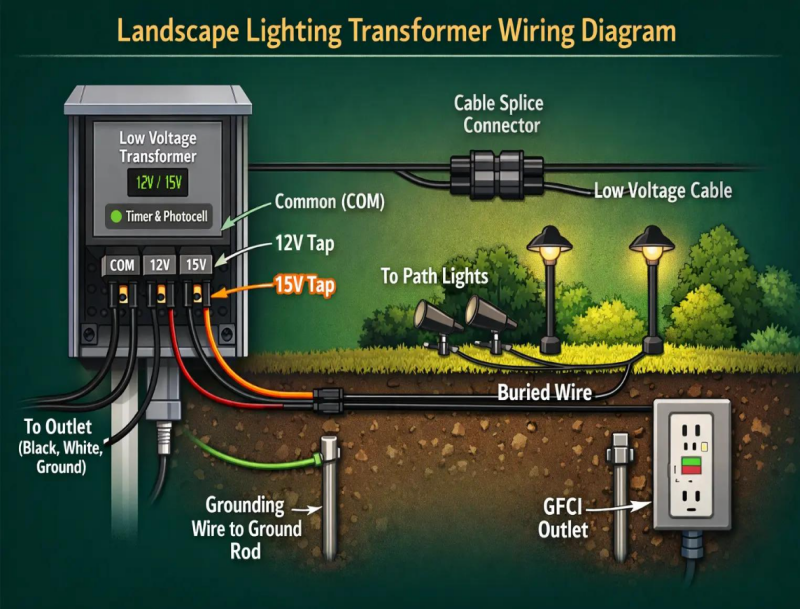
12V LED inground lights are commonly used in low-voltage landscape lighting systems.
They can be suitable for smaller installations where the fixtures are relatively close to the power supply.
2.1 Advantages of 12V LED Inground Lights
Low-voltage operation
A properly designed 12V system can reduce certain electrical shock risks compared with mains-voltage lighting. This is particularly relevant in landscape environments where people may come into contact with outdoor fixtures.
However, low voltage does not eliminate all electrical risks. Power supplies, mains-side wiring and installation conditions still require appropriate protection.
Suitable for small landscape projects
12V lighting can work well in applications such as:
Small residential gardens.
Short pathway lighting circuits.
Decorative landscape features.
Small outdoor courtyards.
Localized garden uplighting.
Widely used in landscape lighting
Many landscape lighting systems are designed around 12V power supplies, making this voltage familiar to landscape installers and maintenance teams.
2.2 Limitations of 12V LED Inground Lights
The main technical consideration is current.
For the same electrical power, a 12V system draws more current than a 24V system.
For example, consider a simplified 60W DC lighting load:
At 12V: 60W ÷ 12V = 5A.
At 24V: 60W ÷ 24V = 2.5A.
This means that, for the same power and cable resistance, the 12V system generally experiences greater voltage drop.
As a result, cable length, conductor size and circuit load must be carefully considered.
12V is worth considering when:
The lighting installation is relatively small.
Cable routes are short.
The power supply can be installed close to the fixtures.
The selected products are specifically designed for 12V operation.
3. 24V LED Inground Lights: A Practical Low-Voltage Option
24V LED inground lights are commonly considered for landscape and architectural lighting projects that require low-voltage operation with more manageable current than an equivalent 12V system.
3.1 Advantages of 24V LED Inground Lights
Lower current than 12V at the same power
For the same electrical power, a 24V DC system draws approximately half the current of a 12V DC system.
This can help reduce voltage drop and cable losses when the cable size and installation conditions are otherwise the same.
Flexible for landscape and commercial projects
24V LED inground lights can be considered for:
Hotel landscape lighting.
Garden and park lighting.
Outdoor pathways.
Commercial plazas.
Building column uplighting.
Landscape feature lighting.
Low-voltage fixture operation
A properly designed 24V system can provide a low-voltage lighting solution while keeping the power supply and electrical distribution arrangement separate from the fixture circuits.
3.2 Why Is 24V Often Considered for Outdoor Landscape Projects?
Compared with 12V, 24V requires less current to deliver the same power.
This can make cable sizing and circuit planning more manageable, especially when multiple fixtures are connected to a shared low-voltage power supply.
However, 24V does not eliminate voltage drop. Long cable routes and high total loads still require proper electrical calculations.
3.3 Limitations of 24V LED Inground Lights
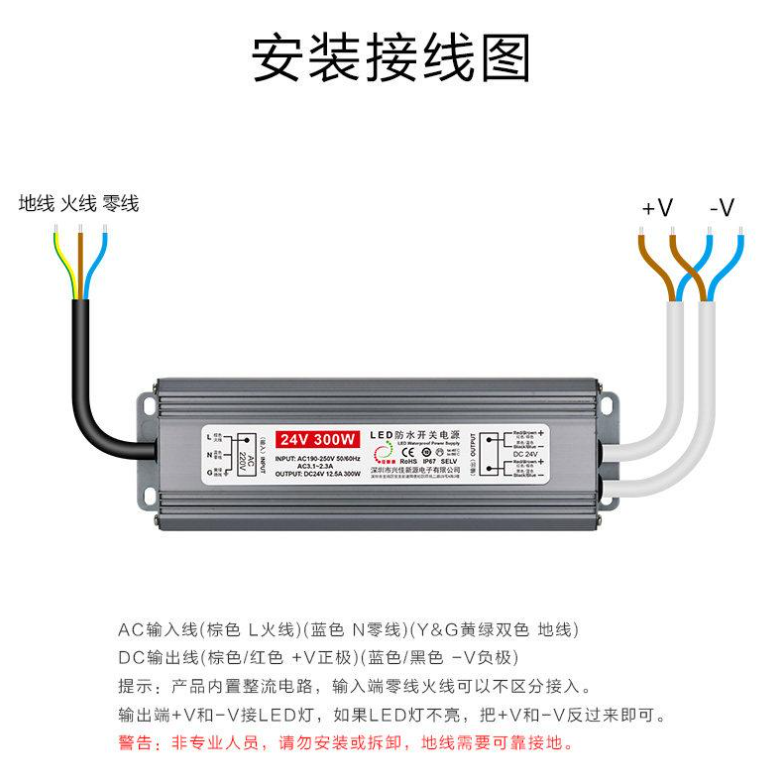
A 24V lighting system normally requires a suitable power supply or driver.
Project designers should consider:
Power supply capacity.
Total fixture wattage.
Cable distance.
Cable conductor size.
Voltage drop.
Power supply installation location.
Protection against moisture and environmental exposure.
The power supply should be installed in a suitable accessible location, with appropriate protection and ventilation according to its specifications.
24V is worth considering when:
The project requires low-voltage lighting.
Several fixtures share a power supply.
Cable routes are longer than those in a small garden installation.
The project needs a balance between electrical design and installation cost.
4. 220V LED Inground Lights: When Is Mains Voltage Suitable?
220V LED inground lights are designed for applications using a compatible mains-voltage supply.
Depending on the product design, the fixture may contain an internal driver or use a suitable external electrical arrangement.
4.1 Advantages of 220V LED Inground Lights
Lower current for the same power
At the same power level, a 220V supply draws much less current than a 12V or 24V supply.
For example, for a simplified 60W load:
12V DC: 5A.
24V DC: 2.5A.
220V: Approximately 0.27A, assuming an idealized unity-power-factor load.
Actual mains input current depends on driver efficiency, power factor and load characteristics.
Lower current can reduce cable voltage drop for a given conductor size, although cable selection must still follow local electrical standards.
Suitable for mains-voltage distribution
For some larger outdoor projects, mains-voltage distribution may be practical when the electrical infrastructure is already designed around this supply arrangement.
May reduce the need for multiple centralized low-voltage power supplies
Depending on the product and project design, mains-voltage fixtures may simplify certain power distribution arrangements.LED inground light spacing
4.2 Limitations of 220V LED Inground Lights
Mains-voltage outdoor lighting requires more attention to electrical safety and installation requirements.
Important considerations include:
Suitable circuit protection.
Appropriate grounding or earthing where required.
Residual-current protection according to local regulations.
Correct cable selection and insulation.
Suitable outdoor electrical connections.
Qualified installation and maintenance.
Inground lights are installed in environments exposed to moisture, soil and outdoor conditions. Mains-voltage wiring and connections must be designed and installed according to applicable electrical codes.
220V is worth considering when:
The project is designed for mains-voltage distribution.
Suitable electrical protection is available.
Qualified electricians can install and maintain the system.
The selected fixture is specifically rated for the intended supply.
5. How Does Voltage Affect Cable Distance and Voltage Drop?
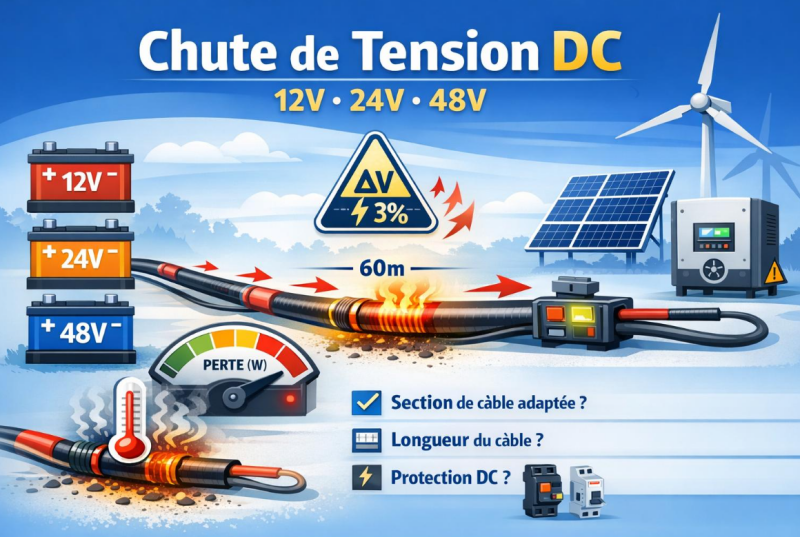
Voltage drop is one of the most important factors when selecting a power supply for outdoor LED inground lights.
When electrical current flows through a cable, the cable's resistance causes a voltage drop. If the voltage at the fixture becomes too low, the light may not operate as expected.
Possible symptoms include:
Reduced brightness.
Uneven output between fixtures.
Flickering or unstable operation.
Driver malfunction or protection activation, depending on the design.
5.1 Why Does 24V Have an Advantage Over 12V?
For a simplified DC constant-voltage system:
[I = \frac{P}{V}]
Where:
I = Current in amperes.
P = Electrical power in watts.
V = Supply voltage in volts.
For the same power, increasing the voltage reduces the current.
For example:
| Total Load | 12V Current | 24V Current |
|---|---|---|
| 24W | 2A | 1A |
| 48W | 4A | 2A |
| 60W | 5A | 2.5A |
| 96W | 8A | 4A |
| 120W | 10A | 5A |
These examples assume ideal DC loads and exclude driver losses.
With the same cable resistance, lower current generally means less voltage drop.
5.2 Basic Voltage Drop Formula for DC Lighting Circuits
For a simple two-wire DC circuit:
[\Delta V = \frac{2 \times \rho \times L \times I}{A}]
Where:
ΔV = Voltage drop in volts.
ρ = Electrical resistivity of the conductor.
L = One-way cable length in meters.
I = Circuit current in amperes.
A = Conductor cross-sectional area in mm².
The factor of 2 accounts for the outgoing and return conductors.
The voltage drop percentage can be estimated using:
[\text{Voltage Drop (%)} = \frac{\Delta V}{V} \times 100]
For actual project design, use the cable manufacturer's resistance data and account for conductor temperature, connection resistance and circuit configuration.
For AC circuits, the calculation may also need to consider power factor, reactance and the specific wiring arrangement.
5.3 How to Reduce Voltage Drop in Long-Distance Lighting Projects
If the distance between the power supply and LED inground lights is long, consider the following measures:
1. Increase cable cross-sectional area
A larger conductor generally has lower resistance and can reduce voltage drop.
2. Divide fixtures into multiple circuits
Instead of connecting every fixture to one long circuit, divide the lighting system into suitable groups.
3. Position power supplies closer to the lighting loads
Where practical, locating the power supply closer to the fixtures can reduce low-voltage cable length.
4. Use a suitable distribution arrangement
For larger projects, an appropriately designed distribution system can reduce current in long cable sections and improve overall efficiency.
5. Calculate the total electrical load
Do not select a power supply based only on the wattage of one fixture. Consider the combined load, cable losses, operating conditions and manufacturer recommendations.
6. How to Choose the Right Power Supply for LED Inground Lights
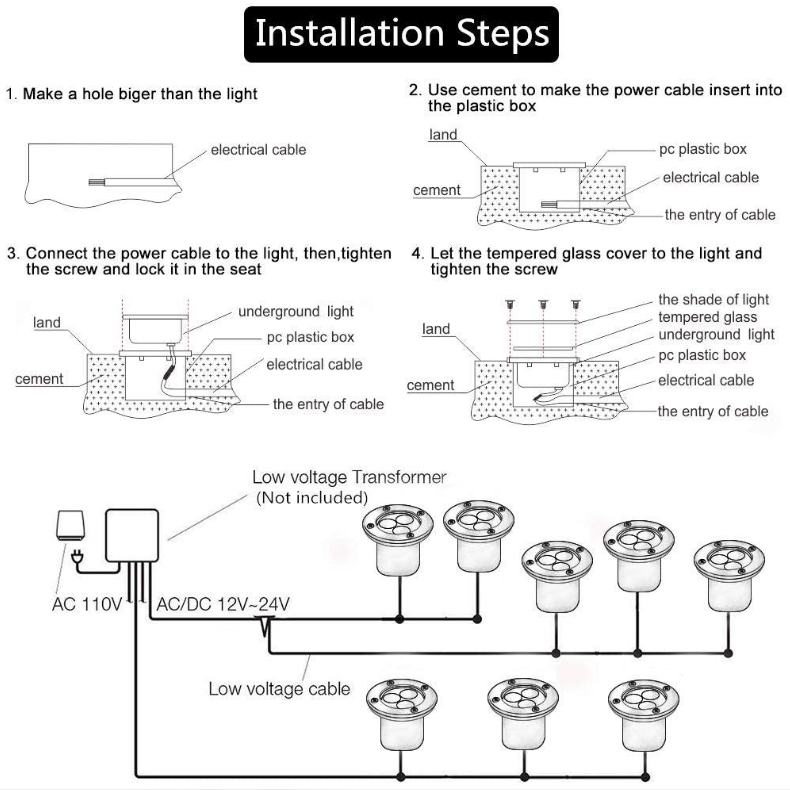
For 12V and 24V LED inground lights, the power supply is an important part of the complete lighting system.
An incorrectly selected power supply can cause unstable operation, excessive loading or premature failure.
6.1 Calculate the Total Fixture Power
For example, if a project uses 20 LED inground lights rated at 6W each:
[20 \times 6W = 120W]
The total nominal fixture load is 120W.
The power supply must be selected based on the actual product requirements, manufacturer recommendations, operating conditions and suitable design margin.
6.2 Check the Output Voltage and Current
Confirm that the power supply matches the fixture's electrical requirements.
For example:
12V DC LED inground lights require a compatible 12V DC output.
24V DC LED inground lights require a compatible 24V DC output.
Do not connect a DC-only fixture to an AC supply unless the manufacturer explicitly specifies AC compatibility.
6.3 Check Power Supply Protectionoutdoor ground light waterproofing
For outdoor projects, consider:
Appropriate environmental protection.
Overload protection.
Short-circuit protection.
Over-temperature protection.
Surge protection where required.
Suitable installation and ventilation conditions.
The power supply should be installed in a location that allows inspection and maintenance.
6.4 Avoid Overloading One Power Supply
If too many fixtures are connected to one power supply, the system may operate outside its intended conditions.
For large projects, dividing the lighting into multiple circuits and power supply groups can make installation, troubleshooting and maintenance easier.
7. Which Voltage Is Best for Different Outdoor Lighting Projects?
The best voltage depends on the project size, cable distance, electrical infrastructure and local safety requirements.
| Project Type | Voltage to Consider | Main Reason |
|---|---|---|
| Small residential garden | 12V or 24V | Suitable for smaller low-voltage systems |
| Hotel garden landscape | 24V | Practical balance for grouped landscape lighting |
| Garden pathways | 12V or 24V | Depends on circuit length and fixture quantity |
| Commercial plaza | 24V or 220V | Depends on power distribution design |
| Large landscape project | 24V or 220V | Requires careful circuit and cable planning |
| Long-distance outdoor lighting | 24V or 220V | Evaluate current, voltage drop and distribution arrangement |
| Building facade and architectural lighting | 24V or 220V | Depends on fixture design and electrical infrastructure |
These are general starting points rather than fixed rules. The correct voltage should be confirmed through electrical calculations and product specifications.
8. 12V vs 24V vs 220V: What Should Buyers Check Before Ordering?
Before purchasing LED inground lights for an outdoor project, confirm the following specifications with the manufacturer.
| Item | What to Confirm |
|---|---|
| Input voltage | 12V, 24V or 220V |
| Input type | AC or DC |
| Operating power | Wattage per fixture |
| Driver arrangement | Internal or external |
| Power supply | Required output voltage and capacity |
| Cable connection | Cable type, length and conductor size |
| Circuit design | Number of fixtures per circuit |
| Control system | On/off, dimming, RGB or DMX512 if required |
| Environmental protection | Suitability for the actual installation environment |
| Electrical documentation | Relevant product specifications and test documents |
For distributors and engineering procurement teams, it is also useful to request a wiring diagram and recommended connection arrangement before confirming the order.
9. Frequently Asked Questions About LED Inground Light Voltage
Q1: Is 24V LED inground lighting better than 12V?
Not in every situation. At the same power, 24V draws approximately half the current of 12V, which can help reduce cable voltage drop. However, 12V may be suitable for smaller installations with short cable runs. The final choice depends on load, distance, cable size and product specifications.
Q2: Is 24V LED inground lighting safer than 220V?
A properly designed 24V low-voltage fixture circuit generally reduces certain electric shock risks compared with a 220V circuit. However, the mains side of the power supply still requires appropriate protection and professional installation. Safety also depends on the complete system and local electrical regulations.
Q3: Can 24V LED inground lights be used for long-distance projects?
Yes, but cable distance, total load and conductor size must be calculated. Long cable routes can still cause voltage drop in a 24V system. Multiple circuits, larger cables or a suitable distribution arrangement may be required.
Q4: How many LED inground lights can one 24V power supply support?
It depends on the power supply capacity and the wattage of each fixture. For example, 20 fixtures rated at 6W have a combined nominal load of 120W. The power supply must be selected with appropriate design margin and according to manufacturer recommendations.
Q5: Do 220V LED inground lights need an external driver?
It depends on the product design. Some fixtures contain an internal driver, while others require an external electrical component. Always check the manufacturer's wiring diagram and input specifications.
Q6: Does a higher voltage mean a longer cable distance?
Not automatically, but higher voltage generally reduces current for the same power. This can help reduce resistive voltage drop for a given cable resistance. Actual allowable distance depends on load, cable size, voltage-drop limits and electrical design.
Q7: Can I connect a 24V DC LED inground light to a 24V AC transformer?
Not unless the product explicitly supports 24V AC input. AC and DC are different supply types. Always check the fixture's input specification before connecting it.
Q8: How do I calculate voltage drop?
For a simple two-wire DC circuit, voltage drop can be estimated using conductor resistance, cable length, current and cross-sectional area.
Conclusion: Choose the Voltage Based on the Complete Electrical Design
12V, 24V and 220V LED inground lights each have suitable applications.
12V: Suitable for small low-voltage landscape lighting systems with appropriately designed short circuits.
24V: A practical low-voltage option for many hotel, garden and commercial landscape projects.
220V: Suitable for outdoor lighting systems designed around mains-voltage distribution and appropriate electrical protection.
For project buyers, the most important factors are not voltage alone. Total power, cable distance, voltage drop, power supply capacity, electrical protection and installation conditions must all be considered.
Looking for 24V LED inground lights or low-voltage LED ground lighting for your project? Request LED inground light specifications Always Lighting to discuss fixture specifications, power supply requirements, cable distance and project applications.