
- 02 Nov 2026
Stainless Steel vs Aluminum LED Inground Lights: Which Is Better?
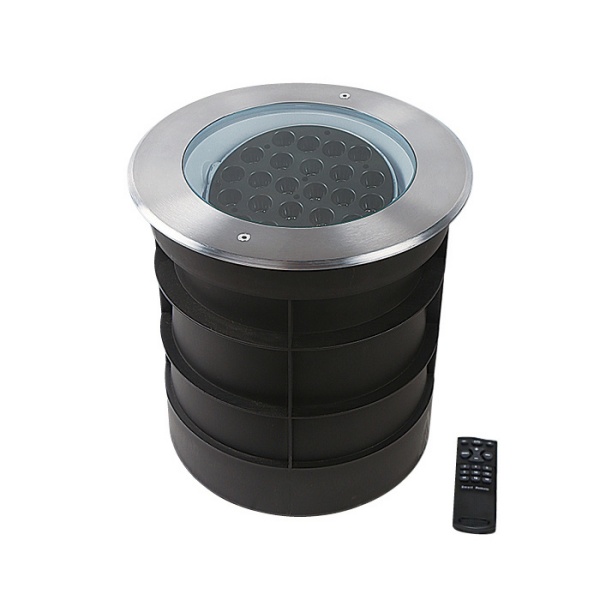
Stainless Steel vs Aluminum LED Inground Lights: Which Is Better for Outdoor Projects?LED Inground Lights
When selecting LED inground lights for outdoor landscape and architectural projects, material selection is an important factor affecting corrosion resistance, durability, maintenance and long-term performance.
Two common housing materials are stainless steel and aluminum alloy. Both are widely used in outdoor lighting, but they have different properties, surface treatment requirements and application considerations.
So, which is better: a stainless steel LED inground light or an aluminum LED inground light?
The answer depends on the project environment. Stainless steel is often selected for applications requiring a durable exposed metal surface and good corrosion resistance, while aluminum alloy offers advantages in weight, thermal management and manufacturing flexibility. However, the actual performance depends on the specific material grade, surface finish, fixture design and installation conditions.
This guide compares stainless steel and aluminum LED inground lights to help landscape contractors, lighting designers, distributors and engineering buyers make informed decisions.
1. Stainless Steel vs Aluminum LED Inground Lights: Key Differences
The main difference is the material itself and how it performs under outdoor conditions.
| Comparison | Stainless Steel LED Inground Light | Aluminum LED Inground Light |
|---|---|---|
| Material | Stainless steel alloy | Aluminum alloy |
| Corrosion resistance | Depends on stainless steel grade and environment | Depends on alloy and surface treatment |
| Weight | Generally heavier | Generally lighter |
| Heat dissipation | Generally lower thermal conductivity than aluminum | Good thermal conductivity |
| Surface treatment | Polishing, brushing, passivation or other finishes | Anodizing, powder coating or other protective finishes |
| Manufacturing | Suitable for durable metal covers and exposed components | Suitable for die-cast housings and complex shapes |
| Material cost | Often higher, depending on grade and processing | Often more economical, depending on alloy and finish |
| Typical applications | Coastal landscapes, premium outdoor areas and exposed installations | Gardens, parks, pathways and general landscape projects |
Neither material automatically guarantees a longer service life. The complete fixture design and quality control process must also be considered.
2. Stainless Steel LED Inground Lights: Advantages and Applications
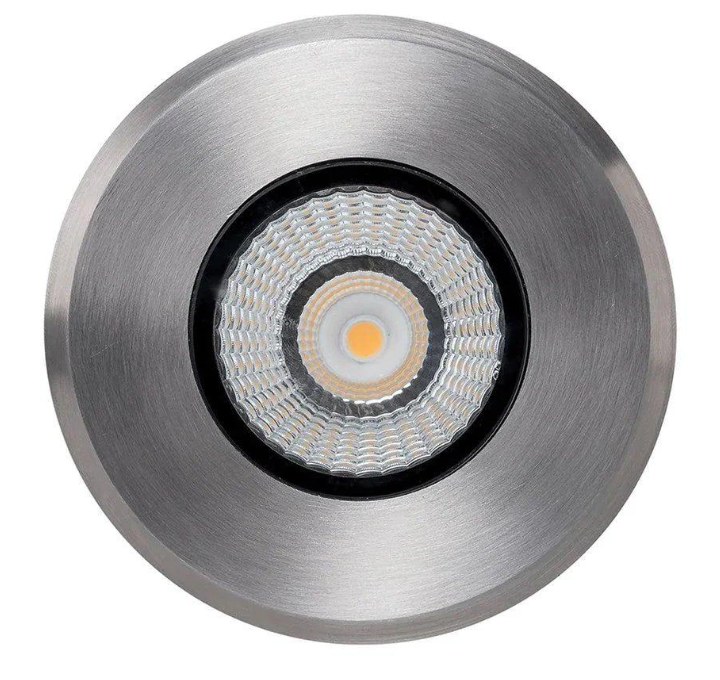
Stainless steel is commonly used in outdoor lighting components because of its corrosion resistance, mechanical properties and appearance.
2.1 Corrosion Resistance
Stainless steel contains chromium, which helps form a protective passive film on its surface.
This film provides corrosion resistance under suitable conditions. However, different stainless steel grades have different resistance levels.
For example:
304 stainless steel: Commonly used in general outdoor applications, but may be vulnerable to chloride-related corrosion in marine environments.
316 stainless steel: Contains molybdenum and generally offers improved resistance to chloride corrosion compared with 304.
For coastal areas, swimming pool surroundings and locations exposed to salt spray, 316 stainless steel may be considered for exposed components where the design and budget justify it.
However, even 316 stainless steel is not completely immune to corrosion. Surface contamination, crevices, stagnant saltwater and poor maintenance can still cause problems.
2.2 Mechanical Strength and Surface Durability
Stainless steel is suitable for applications where the exposed metal components may experience regular contact, handling or mechanical stress.
It can also provide an attractive metallic finish for premium landscape and architectural lighting.
For ground recessed lighting, the material of the visible cover or trim is particularly important because it is directly exposed to the surrounding environment.
2.3 Suitable Applications
Stainless steel LED inground lights can be considered for:
Coastal landscape lighting.
Hotel entrances and outdoor public areas.
Premium garden and courtyard lighting.
Poolside landscape applications, with suitable product design.
Projects requiring exposed metallic finishes.
For projects near the sea, buyers should confirm the exact stainless steel grade rather than accepting a general description such as "stainless steel housing."
3. Aluminum LED Inground Lights: Advantages and Applications
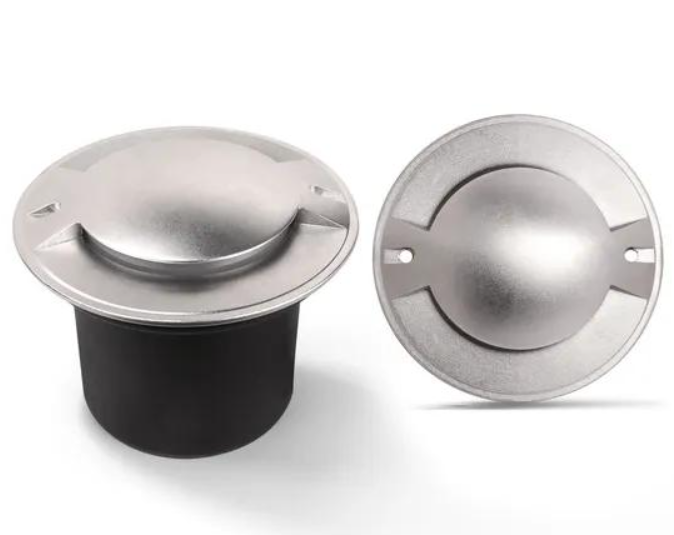
Aluminum alloy is another common material used in outdoor LED lighting.
It is particularly useful for manufacturing fixture housings because of its weight, thermal conductivity and processing flexibility.
3.1 Excellent Heat Dissipation
Aluminum has good thermal conductivity, allowing heat to transfer from LED components to the housing.
Effective thermal management helps control LED operating temperatures and supports stable lighting performance.
For LED inground lights, heat dissipation depends not only on the housing material but also on:
Housing thickness and structure.
Internal heat-transfer design.
LED power and efficiency.
PCB thermal interface.
Ambient temperature.
Installation and surrounding ground conditions.
A well-designed aluminum housing can provide an effective thermal management solution for outdoor LED lighting.
3.2 Lightweight and Flexible Manufacturing
Compared with stainless steel, aluminum alloy is generally lighter.
This can make handling and installation easier, especially for projects involving large quantities of fixtures.
Aluminum die casting also allows manufacturers to produce complex housing structures and integrated heat-dissipation features.
These characteristics make aluminum suitable for different LED inground light sizes, shapes and power ratings.
3.3 Surface Treatment Is Essential
Aluminum naturally forms an oxide layer, but outdoor lighting fixtures often require additional surface protection.
Common surface treatments include:
Anodizing
Anodizing creates a controlled oxide layer on the aluminum surface. It can improve surface hardness and corrosion resistance when properly specified and processed.
Powder Coating
Powder coating provides a protective and decorative finish. Its performance depends on pretreatment, coating quality, film thickness and production control.
Other Protective Coatings
Some projects may require specialized coating systems based on exposure conditions and appearance requirements.
For outdoor inground lights, buyers should ask about the surface preparation process, coating specification and corrosion testing rather than judging durability by appearance alone.
3.4 Suitable Applications
Aluminum LED inground lights are commonly considered for:
Garden and park lighting.
Landscape pathways.
Outdoor building and column uplighting.
Commercial plazas.
General architectural landscape projects.
For coastal or chemically aggressive environments, the aluminum alloy and protective coating system should be selected according to the actual exposure conditions.
4. Which Material Is Better for Coastal and High-Corrosion Environments?
Coastal projects require additional attention because salt spray and chloride exposure can accelerate corrosion.
The selection should consider both the fixture material and the surrounding installation environment.
Stainless Steel in Coastal Environments
For exposed stainless steel components, 316 stainless steel generally offers better resistance to chloride-related corrosion than 304 stainless steel.
However, the following details still matter:
Surface finish and fabrication quality.
Welded areas and crevices.
Contact with other metals.
Salt deposits and cleaning frequency.
Water accumulation around the fixture.
A stainless steel cover does not automatically mean that every internal component is made from the same grade.
Aluminum in Coastal Environments
Aluminum alloy can also be used in coastal projects when the alloy, pretreatment and protective coating are appropriate for the exposure conditions.
Important considerations include:
Alloy selection.
Anodizing or coating quality.
Protection of cut edges and interfaces.
Contact with dissimilar metals.
Avoiding persistent saltwater accumulation.
If aluminum and stainless steel components are connected in a wet environment, galvanic corrosion should also be considered. Suitable material pairing, electrical isolation and design details can help reduce this risk.
Coastal Project Material Comparison
| Project condition | Material considerations |
|---|---|
| General garden and park | Aluminum with suitable outdoor surface protection or suitable stainless steel |
| Urban landscape | Both materials may be suitable; evaluate cost and design |
| Coastal landscape | Consider 316 stainless steel for exposed components or properly protected aluminum |
| Poolside area | Consider chloride exposure, cleaning chemicals and the complete fixture construction |
| High-end hotel landscape | Compare appearance, corrosion requirements and maintenance expectations |
| Areas with standing water | Evaluate the entire enclosure, seals, cable connections and drainage design |
Important: Material selection alone cannot prevent water ingress. Housing construction, sealing interfaces, cable connections and drainage conditions remain essential to long-term reliability.
5. How Do Material, Surface Treatment and Sealing Affect Service Life?
When evaluating an LED inground light, it is important to look beyond the material name.
Three factors should be considered together.LED inground light water ingress
5.1 Material Grade
"Stainless steel" and "aluminum alloy" are broad material descriptions.
Ask the manufacturer to specify the actual grade or alloy used for important exposed components.
For stainless steel, confirm whether the product uses 304 or 316 where relevant.
For aluminum, ask about the alloy and its suitability for the intended outdoor exposure.
5.2 Surface Treatment Quality
Surface treatment can significantly influence how a metal component performs outdoors.
For stainless steel, appropriate finishing and cleaning practices help maintain the passive surface condition.
For aluminum, suitable pretreatment and anodizing or coating processes help protect the substrate.
A coating with poor adhesion, incomplete coverage or inadequate pretreatment may deteriorate earlier than expected.
5.3 Sealing and Fixture Construction
Even corrosion-resistant materials cannot compensate for poor sealing design.
Pay attention to:
The contact between the glass lens and housing.
Gasket material and compression.
Cable entry protection.
Fasteners and connection points.
Water accumulation around the fixture.
For more information about moisture-related problems, read our related article: Why Do LED Inground Lights Fail After Heavy Rain?
6. Stainless Steel vs Aluminum: Which Is More Cost-Effective?
Material cost is an important consideration for landscape contractors, distributors and project procurement teams.
However, the lowest purchase price does not always represent the lowest long-term project cost.
A more complete comparison should include:
Initial fixture cost.
Surface treatment requirements.
Installation and handling costs.
Maintenance frequency.
Replacement costs.
Expected exposure conditions.
| Cost factor | Stainless Steel | Aluminum Alloy |
|---|---|---|
| Initial material cost | Often higher, especially for higher-grade stainless steel | Often more economical, depending on alloy and finish |
| Weight and handling | Generally heavier | Generally lighter |
| Surface protection | Depends on grade and finishing | Protective treatment is usually important |
| Heat management | Requires suitable thermal design | Good thermal conductivity |
| Long-term maintenance | Depends on grade, finish and environment | Depends on coating condition and environment |
For large landscape projects, it is useful to compare products with equivalent power, optical performance, construction and testing requirements. Comparing material names alone can lead to an inaccurate purchasing decision.
7. How to Choose the Right LED Inground Light for Your ProjectOutdoor LED Inground Light
Before selecting a material, answer the following questions.
Step 1: Identify the Installation Environment
Is the fixture installed in a garden, public plaza, hotel entrance, coastal landscape or poolside area?
Identify exposure to salt spray, irrigation water, cleaning chemicals, soil moisture and standing water.
Step 2: Confirm the Required Material Grade
For stainless steel, confirm the grade.
For aluminum, confirm the alloy and surface protection process.
Step 3: Evaluate Thermal and Optical Performance
Check LED power, heat dissipation, beam angle, lumen output and optical design.
The material should support the fixture's thermal and structural requirements.
Step 4: Check the Complete Enclosure and Connection Design
Review the lens interface, gasket, cable entry and external connection system.
A durable housing is only one part of a reliable outdoor lighting product.
Step 5: Compare Total Project Cost
Compare products based on actual specifications, quality documentation, installation requirements and expected maintenance.
This gives procurement teams a more reliable basis for selecting the right product.
8. Frequently Asked Questions
Q1: Are stainless steel LED inground lights better than aluminum LED inground lights?
Not in every situation. Stainless steel may be suitable for exposed components requiring corrosion resistance, especially when an appropriate grade is selected. Aluminum offers good heat dissipation, lower weight and manufacturing flexibility. The best choice depends on the project environment and fixture design.
Q2: Is 316 stainless steel better than 304 for outdoor inground lights?
For environments exposed to salt spray and chlorides, 316 stainless steel generally offers better corrosion resistance than 304. However, actual performance also depends on surface condition, fabrication, maintenance and exposure.
Q3: Can aluminum LED inground lights be used in coastal areas?
Yes, if the alloy and protective surface treatment are suitable for the actual coastal environment. Buyers should check the coating process, corrosion protection and design of exposed interfaces.
Q4: Which material has better heat dissipation?
Aluminum generally has higher thermal conductivity than stainless steel, making it useful for transferring heat away from LED components. Actual fixture temperature also depends on the housing design, LED power, PCB and thermal interfaces.
Q5: Does stainless steel prevent corrosion completely?
No. Stainless steel is corrosion-resistant, not corrosion-proof. The grade, surface condition, chloride exposure, crevices and maintenance all affect its performance.
Q6: Which LED inground light material is more suitable for hotel landscape projects?
Both can be suitable. Aluminum may be considered where weight, thermal design and project cost are important. Stainless steel may be preferred for exposed finishes or applications with specific corrosion requirements. The final choice should be based on the hotel's location, design and maintenance conditions.
Q7: Does a stainless steel housing mean the entire fixture is made of stainless steel?
Not necessarily. Some fixtures use stainless steel for the exposed cover or trim while other parts are made from aluminum or other materials. Ask the manufacturer for a material breakdown of the complete fixture.
Conclusion: Choose the Material Based on the Project Environment
Stainless steel and aluminum LED inground lights each have practical advantages for outdoor lighting applications.
Stainless steel, especially an appropriate grade such as 316, may be considered for exposed components in coastal or chloride-rich environments. Aluminum offers good thermal conductivity, lighter weight and flexible manufacturing options, making it suitable for many landscape and architectural projects when properly protected.
For long-term outdoor performance, do not evaluate the material alone. Consider material grade, surface treatment, sealing structure, cable connections, drainage and thermal design together.
Looking for LED inground lights for your landscape or architectural project? Contact Always Lighting to discuss your application, material requirements and product specifications.