
- 22 Oct 2026
Hotel Pool and Fountain Lighting: Specifying IP68 Underwater Lights That Stay Sealed
An underwater light works in the least forgiving position on any project: immersed permanently, in chemically treated water, where people swim — and when it fails, the repair starts with a diver or a partial drain-down. Almost none of those failures are LED failures. They are sealing failures, chemistry failures and installation shortcuts, and they punish optimistic specification for decades.
1. Safety First: The 12-Volt Rule Is Not a Preference
Two standards frame every pool-lighting decision. The installation rules — IEC 60364-7-702 — divide the pool and its surroundings into zones, the water itself being zone 0. The product standard — IEC/EN 60598-2-18 — covers luminaires used in or in contact with pool and fountain water. Between them, the electrical architecture is not really a design choice:
In the water, only SELV. Zone 0 permits only safety extra-low voltage not exceeding 12 V AC or 30 V DC, and the luminaire standard mirrors it: pool luminaires are Class III, at the same limits. The familiar "12 V pool light" is the market's answer to a legal ceiling, not a product category.
The source stays out of the water zones. The safety isolating transformer (to IEC 61558-2-6) or equivalent SELV supply sits outside zones 0, 1 and 2, its supply circuit protected by a 30 mA RCD. Transformers and drivers belong in the plant room — never in the niche, never underwater.
Parts touching water must be pressure-watertight. Under 60598-2-18, parts in contact with the water are classified pressure-watertight IPX8; parts out of the water still need at least IP54.
Bonding is part of the system. The installation rules require supplementary equipotential bonding of all conductive parts in the zones — metal niches, ladders, pipework. A fixture schedule that ignores the bonding around it is half a specification.
Low voltage buys safety at a price: voltage drop. A 12 V run loses a visible share of its voltage over a long, thin cable, and the far fixture runs dimmer than the near one. Size secondary cables for drop; keep runs short.
Fountains differ in detail — there is no zone 2 around a fountain, and basins nobody enters may use additional protective measures — but any fountain guests can walk or paddle in should be specified to the pool rule. Mains-voltage luminaires have no place in the water under IEC practice; where they appear, it is under different national code traditions. Do not let a catalogue talk you out of low voltage.
2. Sealing for Permanent Immersion: IP68 Is the Start of the Spec, Not the Spec
Here is the misunderstanding that fills warranty files: IPX8 has no fixed test. Under IEC 60529, IPX7 is a defined immersion (1 m, 30 minutes); IPX8 means continuous immersion under conditions — depth and duration — declared by the manufacturer, more severe than IPX7. Two fixtures can both be honestly labelled IP68, one proven at 1.5 m, one at 10 m. So the specification is not "IP68"; it is "IP68 for continuous immersion at installed depth plus margin", with the declared conditions in the document pack.
Beyond the rating, two construction philosophies divide the market:
Fully potted, factory-sealed fixtures. The housing is resin-filled; there is no gasket joint in the water path and nothing for a technician to open. Sealing is the factory's work, not the serviceman's. The trade: when the LED or driver dies, the whole fixture is replaced.
Serviceable fixtures. A face ring, gasket or O-ring and a replaceable light engine. Lifetime cost can be lower — but every opening is a re-sealing event performed poolside, dependent on O-ring condition, cleanliness and torque. Hotels with strong engineering teams run these well; others usually cannot.
Whichever type, the cable is part of the seal. Specify a factory-fitted cable with a moulded or potted entry, long enough to reach the deck connection with the service loop below. There must never be a cable joint underwater or in a flooded niche: a hand-made joint in the wet is where "IP68" installations actually leak. And respect duty: some fixtures are marked for use only when immersed, using the water as their heatsink. Fountains that drain and refill need ratings for intermittent duty: thermal cycling makes a housing breathe, and moist air through a marginal seal ends as condensation inside the lens.
3. Chemistry: Chlorine Eats Specifications
Pool water is a warm, oxidising chemical bath, held at a few parts per million of free chlorine for decades. A saltwater pool is not gentler: the salt cell generates the same chlorine from roughly 3,000–5,000 ppm of dissolved salt, so the fixture sees chlorine and a high chloride load — far below seawater's ~35,000 ppm, far above fresh water.
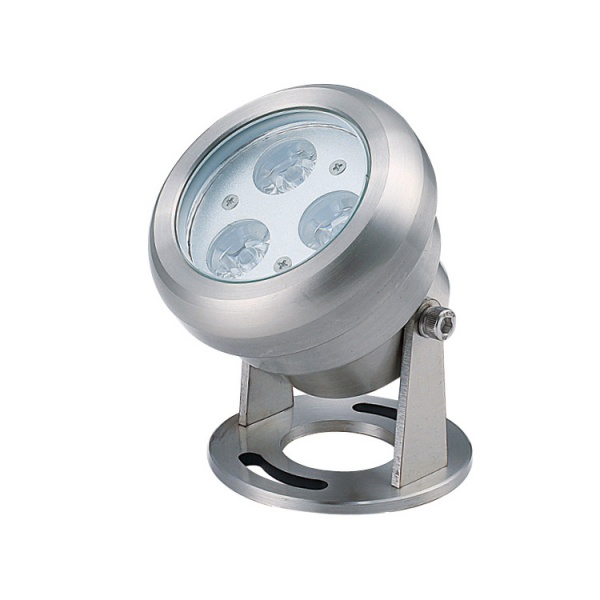
Stainless grade is the decision. 304 has no molybdenum and pits in chlorides, starting at crevices and welds; 316/316L resists. Specify 316L for wetted metal in chlorinated pools as the baseline; for salt-chlorination systems, treat it as non-negotiable. Across the IP68 LED underwater lights on the market, insist on the grade in writing — not "stainless steel".
Plastics are legitimate — with conditions. Engineered-plastic bodies do not corrode and suit smaller fixtures, but confirm chlorine and UV resistance; a plastic body also sheds heat poorly, which caps wattage.
Keep wetted metals compatible. A stainless fixture against dissimilar-metal niches, screws or pipework in the same water is a galvanic couple. Specify matching or isolated hardware.
4. Light in Water: Colour, Beams and Choreography
Water edits the light. It absorbs the red end of the spectrum first, so output loses warmth with distance and depth: a 3000K scene reads cooler across a 25 m pool than at the wall, and RGB scenes drift blue-green over long throws. Design colour at the real throw distance, not in the sample tank.
The pool finish is the other half of the photometrics. White and pale finishes return most of the light; deep-blue and near-black finishes absorb it — the same schedule can look generous in one hotel and starved in the next. State the finish colour in the lighting calculation. Wall fixtures are normally aimed across the water so swimmers are not staring into sources at eye level; glare control — recessed optics, diffused or asymmetric lenses — is a bather-comfort specification, not a luxury. In fountains, spacing follows the hydraulics — nozzle layout first, fixture layout second — with uplights ringing the nozzles.
For choreographed fountains, DMX is the standard control tool — but specify a system the hotel's own engineer can operate in year five: stored scenes, a simple scheduler, documented addressing, no dependence on one obsolete laptop.
5. Installation and Maintenance: Design for the Day It Fails
Niches and sleeves are cast into the pool shell, coordinated with the fixture model at design stage — retrofitting means core-drilling a waterproofed shell. The niche is part of the waterproofing, and the failure pattern is identical to drive-over inground lights: water arrives through the cable entry or the housing, rarely through the front lens.
One detail decides the next twenty years of maintenance cost: the service loop. Specify enough factory cable coiled in the niche for the fixture to be lifted clear of the water and set on the deck for cleaning, inspection or replacement — without draining the pool. A fixture that can reach the deck gets maintained; one that cannot gets deferred, then abandoned.
Then, before the water goes in:
Test everything at the deck. Continuity, insulation, every fixture at full output, and every DMX address verified while the evidence is still dry.
Buy spares from the same batch. One or two spare fixtures per type, ordered with the original production run, so LED colour, trim and connectors match the aged installation.
Plan the cleaning. Lenses foul with scale and biofilm; output falls well before anything "fails". If the fixture lifts to the deck, cleaning is routine. If it cannot, it will not happen.
6. Pre-Order Checklist
☐ Fixtures to IEC/EN 60598-2-18: Class III, ≤12 V AC / ≤30 V DC, IPX8 for all water-contact parts
☐ IP68 declared with depth and duration — installed depth plus margin, continuous immersion
☐ SELV source outside zones 0/1/2; 30 mA RCD protection; equipotential bonding in the installation design
☐ Construction type chosen deliberately: fully potted, or serviceable with a realistic re-sealing procedure
☐ Factory-fitted cable, no underwater joints, length sufficient for the niche-to-deck service loop
☐ Wetted metal 316/316L for chlorinated water — mandatory for salt-chlorination pools; plastics confirmed chlorine- and UV-resistant
☐ Output and beam checked against pool finish colour and real throw distances; glare at swimmer eye level addressed
☐ Fountain control specified as a maintainable system: stored scenes, scheduler, documented DMX addressing
☐ Niches/sleeves coordinated with the fixture model at shell-design stage
☐ Same-batch spare fixtures included in the order
☐ Full-output and control test scheduled before filling
If you are fixing the underwater schedule for a hotel pool or fountain, send Always Lighting the drawings or the key dimensions — water depth, pool finish colour, and whether the water is fresh, chlorinated or salt-chlorinated. The schedule can then be specified against the actual basin, not a generic datasheet. Reach us through the WhatsApp or email buttons on this site — these details are all decided before the water goes in, which is exactly when they cost nothing to change.