
- 22 Oct 2026
Drive-Over Inground Lights: Load Ratings, IP67/IP68 and Installation Mistakes That Kill Uplights
An inground light occupies the harshest position of any fixture on a project. It is driven over, stood on, flooded, pressure-washed and buried out of sight, where nobody notices it failing until the paving comes up. Contractors who replace dead uplights for a living know the pattern: the LED module is rarely the problem. Failures are specified in — a load rating nobody interrogated, a waterproofing figure applied to the wrong half of the system — or installed in, through drainage and cable details never drawn. This guide works through the three killers in order: load, water, and installation.
1. Load Ratings: What the Kilogram Figure Actually Means
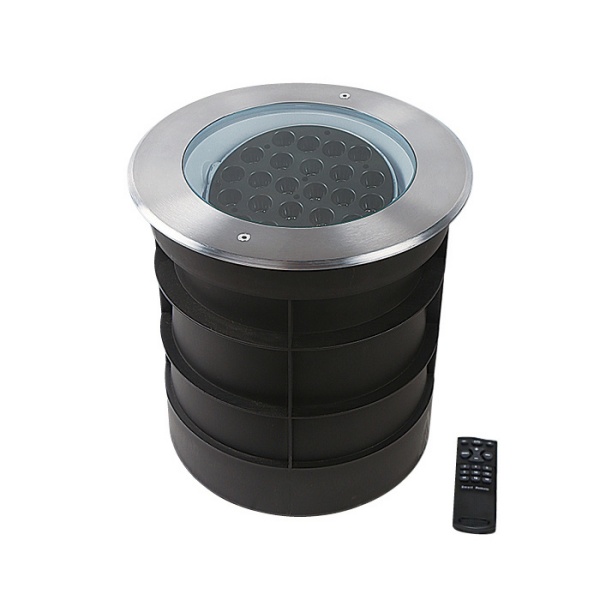
Every drive-over datasheet quotes a maximum static load, in kilograms or kilonewtons (1 kN ≈ 102 kg of force). Understand it: the load a correctly installed sample withstood when force was applied slowly, through a defined contact patch, in a test rig. Ground recessed luminaires sit under their own standard, EN 60598-2-13, which includes resistance to static load and — tellingly — to torque and shear loads. The standard sets test methods, not a universal "drive-over number" that transfers between brands: the result depends on glass thickness, housing geometry, the sleeve, and the size of the patch the load is spread over. Some datasheets show this openly, quoting a different kilogram figure for each contact diameter.
What a static figure does not cover:
Dynamic and scrub loads. A parked car's wheel rests statically at roughly a quarter of the vehicle's weight — a few hundred kilograms for a family car, far more per axle on a loaded van. But a wheel steering while stationary, or braking as it crosses, scrubs the glass sideways. That shear is harder on trims, gaskets and glass edges than the vertical load, which is why the standard tests torque and shear separately.
Point loads. Load on a small area — a stiletto heel, a jack stand, a furniture foot — concentrates stress that a headline figure, tested through a broad pad, never simulated.
Speed and repetition. Some datasheets declare a maximum vehicle speed alongside the load (low-speed limits such as 30 km/h appear on real products). A fixture crossed twice a day and one crossed two hundred times a day live different lives at the same rating.
So specify by location class, not by the biggest number on the page:
Pedestrian only — paths, plazas, steps. Still check what maintenance traffic crosses it: sweepers and cherry pickers are vehicles too.
Occasional vehicle — hotel forecourts, crossing points, vehicles at walking pace, wheels rolling straight.
Regular driveway or parking — cars turning and braking on the fixture. This is the true drive-over class: demand a declared static load with margin, the declared application area from the manufacturer, and the torque/shear test basis.
Carriageway-adjacent — only fixtures explicitly declared for trafficked areas; many specifiers keep fittings out of the running lane, which is usually the cheaper decision.
Ask for the load figure with its test basis; treat "drive-over" as a word, not a specification. Product listings for LED inground lights should be read the same way — the number and its conditions, or it did not happen.
2. Water: IP67 vs IP68 Is Only Half the System
Both ratings start with 6: dust-tight under IEC 60529. The second digit is where they part. IP67 certifies temporary immersion — 1 metre of water for 30 minutes. IP68 certifies continuous immersion beyond 1 metre, under conditions the manufacturer must declare: depth and duration are part of the rating, not fine print. An IP68 fixture declared at 1.5 m for 30 minutes has barely out-tested an IP67 unit; an IP68 declaration of several metres, continuously, is a different product. Never compare the digits — compare the declared conditions.
Then accept the harder truth: the IP test is performed on the fixture, on a bench, with its factory cable entry. The installed system has three more water paths the test never met:
The sleeve. The recessing housing sits in the ground exactly where water collects. Without a drainage layer — a gravel bed under and around the sleeve, with somewhere for the water to go in clay soils — the sleeve becomes a bucket and the fixture lives submerged whatever its rating. Drainage does not replace the IP rating; it decides how much of the time the rating is being used.
The cable. Water travels along cables and through badly matched glands, and it enters at joints. A gland specified for a different cable diameter, left undertightened, is an open door with an IP68 sign on it. Buried joints belong in sealed, burial-rated enclosures or resin/gel systems — never tape and hope.
Condensation. A buried fixture heats by day and cools by night, pumping moist air through its weakest path; moisture sealed in during a humid installation condenses on the glass from inside — which is why some fixtures mist up without ever leaking. Fit breathable membrane vents where offered, and assemble dry.
Specify the installation system — fixture, sleeve, drainage detail, gland and joint method — as one item on the drawings. An IP figure quoted for the fixture alone describes a product that will never exist on your site.
3. Installation Mistakes That Kill Uplights
The recurring failures, in roughly the order contractors meet them:
No drainage. The pit is dug, the sleeve dropped in, the paving closed — and the first storm fills it. See above: everything downstream of this mistake is a countdown.
Sleeve set wrong. Wrong depth or off-level sleeves leave trims sitting proud (a trip edge and a point load) or sunken (a puddle with a light in it). Unfixed housings also float or shift while concrete is poured.
Concrete poured hard against the fixture. No expansion room and no service clearance: the fixture cannot be lifted out without breaking the surface, and thermal movement works against the seals ever after.
Buried, unsealed cable joints — or joints left inside the sleeve below the water line. The single most common water entry point in failed uplights.
Drivers buried with the fixture. If the driver is integral and the paving is closed, every driver failure is an excavation. Remote drivers need an accessible location agreed before the pour, not after.
Testing after paving. Circuits, output, aiming of adjustable optics and control addressing all checked only once the surface is finished — so every fault becomes demolition. Test, aim and photograph every run before it is covered.
Cable stuffed into the housing. Excess cable coiled into the sleeve stops the fixture seating on its gasket; glands cross-threaded or mismatched undo the rating the buyer paid for.
None of these is a product defect, and no warranty conversation will treat them as one.
4. Materials and Heat: The Buried Fixture's Two Slow Problems
Trim ring and fixings. The stainless ring is the visible, load-bearing, weather-facing part. Grade 304 is adequate inland. In coastal air or chlorinated splash zones — poolside uplights get both — specify 316: its molybdenum content is what resists the chloride pitting and crevice corrosion that perforates 304. The grade must cover screws and fixings too, not only the headline ring. Our Gulf outdoor fixture specification guide works through the same chloride logic for coastal projects in detail.
Glass. Drive-over covers are tempered (toughened) glass, and thickness follows load class — datasheets for genuine drive-over models commonly sit in the 8–12 mm range; ask for the stated thickness rather than assuming it. In pedestrian areas add two checks: an anti-slip or textured finish where wet feet meet polished glass (it costs a little output), and accessible-surface temperature — EN 60598-2-13 sets surface-temperature requirements for this fixture class, which matters where children and bare feet meet a fitting that has run all evening.
Heat. A buried fixture has no free air. Soil and concrete conduct heat away far worse than open air, the sleeve traps a pocket of still air around the body, and every watt is heat that must leave through that path. High wattage in a small buried can is a derating exercise: ask at what ambient the lifetime figures were calculated, keep integral drivers' temperature in the same conversation, and treat a remote driver as a thermal as well as a maintenance decision.
5. Checklist: Before Ordering, Before Paving
Pre-order
☐ Every fixture position classified: pedestrian / occasional vehicle / regular driveway — and the load figure checked against that class, with its test basis
☐ IP rating read with its declared conditions (IP68 depth and duration in writing)
☐ Sleeve, drainage layer and joint method specified on the drawings, not left to site habit
☐ Stainless grade stated for ring and fixings (316 for coastal or poolside positions); glass thickness stated
☐ Driver location decided: integral or remote, and accessible either way
Pre-install
☐ Drainage layer in place and falling somewhere; sleeves fixed, level, at finished height
☐ Glands matched to the actual cable; joints in burial-rated sealed enclosures only
☐ Every circuit powered, aimed and photographed before the surface is closed
☐ Expansion and service clearance left around each fixture; no excess cable inside housings
If you are setting inground fixtures into a driveway, plaza or poolside deck, send Always Lighting the project layout — where each fixture sits and what crosses it — and the load and IP specification can be checked against the positions before you order. Reach us through the WhatsApp or email buttons on this site; a position moved on the drawing costs nothing, and the same move after paving costs a demolition crew.