
- 22 Oct 2026
Specifying Outdoor LED Fixtures for Gulf Projects: 50°C Heat, Sand, Salt Air and What Actually Fails
Ask a maintenance contractor in Dubai, Riyadh or Doha what kills outdoor LED fixtures, and you will rarely hear "the LEDs." A modern LED package is the most reliable component in the fitting. What fails is everything around it: drivers cooked inside sealed housings, gaskets that harden until the desert gets in, finishes that surrender to salt air within two summers. The Gulf is not one hostile environment but three stacked together — extreme heat, airborne sand, and along the coast some of the most corrosive air in the world. A fixture rated for five quiet years in a temperate city can be scrap in two on a Gulf corniche if it was specified from a temperate-climate datasheet.
1. Heat: The Number That Decides Everything
Summer air temperatures across Kuwait, Saudi Arabia and Qatar routinely exceed 50°C, and Gulf project specifications commonly rate outdoor equipment for 50–55°C ambient. Against that, most catalogue ratings are quoted at 25°C — a laboratory number that says little about a fixture bolted to a sunlit facade in August, where a dark housing in direct sun can sit 20°C or more above the air around it.
What matters is not the air temperature but two internal temperatures: the LED junction and the driver case temperature (Tc). Heat destroys the driver first, through its electrolytic capacitors: the widely used rule of thumb (an Arrhenius estimate, not a guarantee) is that capacitor life roughly halves for every 10°C rise in operating temperature and doubles for every 10°C fall. Run a driver 20°C hotter than its rating point and expect roughly a quarter of its headline life. This is why drivers, not LED packages, dominate Gulf failure reports.
Specify accordingly:
A maximum ambient (Ta) rating of at least 50°C for the complete fixture, not just the LED board — and ask at what Ta the quoted lifetime figures were calculated.
Driver case-temperature data at that ambient: a thermal test report or Tc measurement from a production sample, not a brochure value.
Thermal design you can inspect — die-cast housing mass around the light engine, fin area that sheds heat without trapping dust, and a driver compartment separated from the LED heatsink — or a remote driver — so the two heat sources do not cook each other.
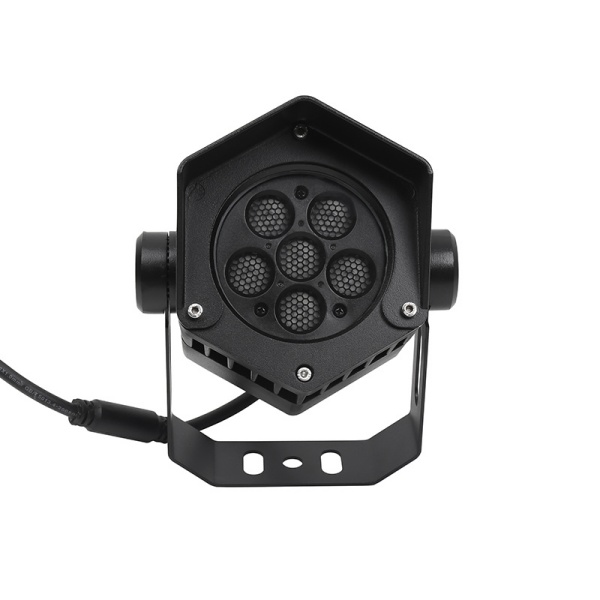
For high-power LED flood lights on facades and towers, treat this as the first calculation in the spec: wattage is heat.
2. Sand and Dust: Dust-Tight Is Not a Marketing Word
The IP code's first digit is where desert specifications are won or lost. Under IEC 60529, IP6X means dust-tight — no ingress of dust under test. IP5X, "dust-protected," explicitly permits some dust to enter, so long as it does not interfere with operation on the day of the test. In a climate where fine sand is airborne for much of the year and shamal winds drive it at every seal, "some dust" is a daily delivery. Inside the fixture it cuts light output month by month and insulates the heatsink, feeding the heat problem above.
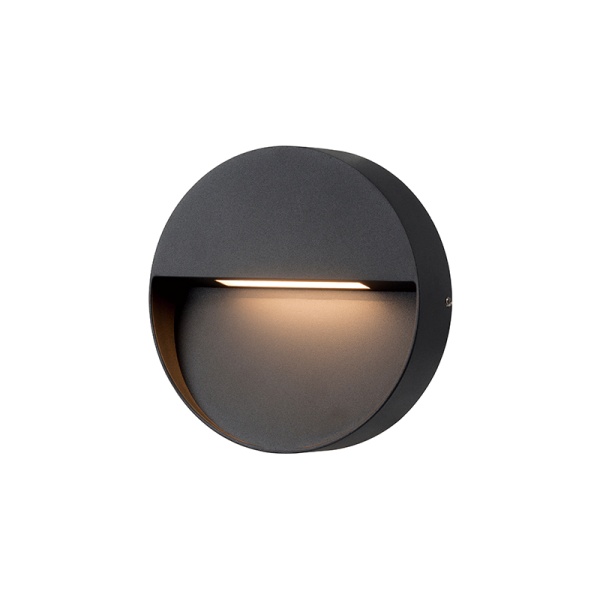
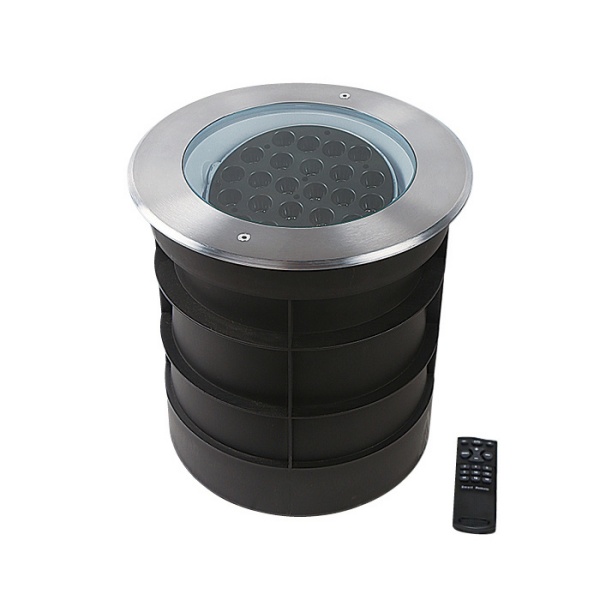
Specify IP6X dust-tightness (IP66 as the usual complete rating) as the floor for inground, flood and wall-washer fixtures; reserve IP5X for sheltered positions, if at all.
Specify the gasket material, not just the rating. A seal is only as good as its elastomer after three summers. Silicone gaskets are the usual specification for high heat and UV because they keep their elasticity; cheap polyurethane foam gaskets take a permanent compression set, crumble, and quietly convert an IP66 fixture into an IP44 one.
Ask about pressure equalisation. A sealed housing heats by day and cools by night, pumping air — and moisture — through its weakest path, usually the cable gland. A membrane breather vent lets the housing equalise pressure without admitting dust or water. Prefer it to a sealed box that breathes through its seals.
Expect abrasion. Wind-blown sand sandblasts exposed optics. Tempered glass fronts resist it far better than unprotected polycarbonate lenses; where polycarbonate is used, ask about UV stabilisation and hard coatings, and plan cleaning access.
3. Salt Air and Corrosion: Treat the Coast as C5
The coastal Gulf combines salt aerosol, high humidity and high temperature. In ISO 12944 terms, C5 is "very high" corrosivity (coastal areas with high salinity) and CX covers extreme, offshore-type exposure. Inland Riyadh and a JBR or Corniche waterfront are different specification problems; write the coastal one as C5 and think CX for splash-zone and marina hardware.
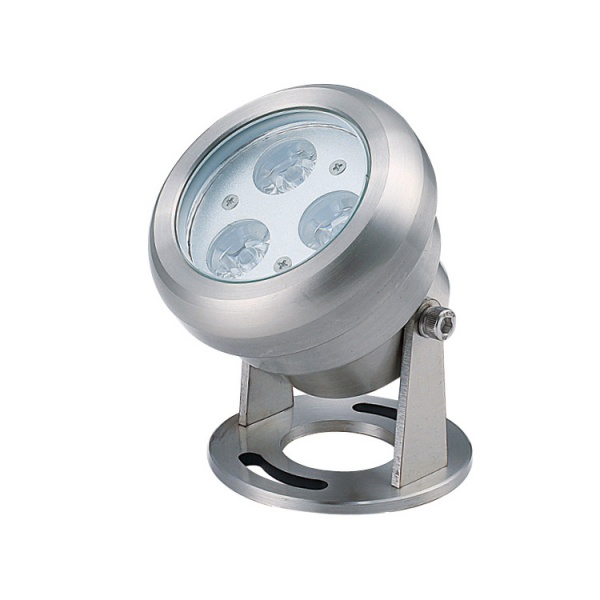
Stainless grade is a chloride decision. Grade 316 adds 2–3% molybdenum, which is what resists chloride pitting and crevice corrosion; 304 has none and tea-stains, then pits, in coastal air. Specify 316 or 316L for fasteners, brackets, inground sleeves and any exposed stainless part on coastal projects — and the same logic governs LED underwater lights in hotel pools and fountains, where chlorinated water attacks 304 fittings all year round.
Powder coat is a system, not a colour. On aluminium housings, corrosion starts where the coating is thin, damaged or poorly bonded: edges, screw holes, the back face nobody inspects. Specify the pre-treatment (a conversion coating under the powder), a minimum dry-film thickness, and ask how many hours of neutral salt-spray testing (ASTM B117) the finish system has passed — a number, not the words "anti-corrosion."
Isolate dissimilar metals. Stainless fasteners in aluminium housings, aluminium fixtures on galvanised poles: add salt water and the joint becomes a battery that corrodes the less noble metal. Specify insulating washers or jointing compound at mixed-metal interfaces and matching fastener materials.
Design out crevices. Standing water in seams and unsealed overlaps holds salt against the metal, so drainage paths and sealed seams belong in the fixture review, not the snagging list.
4. Electrical Reality: The Grid Is Part of the Environment
Gulf grids are generally good, but a fixture's electrical environment includes long exposed feeder runs, construction-site supplies, generator changeovers and switching of large cooling loads. Transients ride in on the cable, and lightning — less frequent than in the tropics — still induces surges on long outdoor runs.
Specify surge immunity as a number of kilovolts. For exposed outdoor installations, 10 kV (including common-mode, line-to-earth) is a widely used benchmark in street and facade specifications; a bare "built-in surge protection" line with no figure is not a specification. Note the varistors providing it degrade slightly with every event absorbed.
Add an external, replaceable SPD where access is expensive — tower facades, high-mast and long pole runs — so protection can be renewed without replacing the fixture, and confirm the earthing it depends on exists on site.
Name the driver. In most field experience the driver is the fixture's life-limiting component: brand and series should be stated in the spec or subject to written approval before any substitution, with its rated life quoted at maximum case temperature and an input range tolerant of site voltage fluctuation.
Keep control wiring in the same conversation — long DALI or DMX runs are also surge paths, and control gear deserves the same protection as the mains input.
5. What Actually Fails First
Field failures in Gulf outdoor lighting follow a consistent order:
Drivers — heat-aged capacitors and surge damage. Prevented by the Ta/Tc, named-driver and surge clauses above.
Gaskets and seals — hardening, compression set, then dust and water ingress that corrodes boards from inside. Prevented by the silicone-gasket, breather-vent and IP6X clauses.
Finishes and hardware — coating breakdown at edges, pitting of 304 hardware, galvanic attack at mixed-metal joints. Prevented by the 316, coating-system and isolation clauses.
Optics — sand abrasion and UV yellowing of low-grade polycarbonate, seen as lost output rather than darkness. Prevented by the glass/UV-stabilised-optic clause.
LED packages — last, and usually as gradual lumen depreciation when everything above was specified properly. When a failure report blames "the LEDs," open the driver compartment before you believe it.
The conformity paperwork must name the same models — for Saudi and UAE imports, run it through our SABER and ECAS guide before production.
6. The Gulf Spec Checklist
Clauses to paste into an RFQ or fixture schedule:
☐ Fixture rated for continuous operation at Ta 50°C minimum; lifetime and driver-life figures stated at that ambient; thermal test data available
☐ Enclosure IP66 minimum (IP6X dust-tight); IP67/IP68 where immersion or ground-level flooding applies
☐ Gaskets silicone; membrane breather vent fitted; cable entries via correctly rated glands
☐ All external stainless steel 316/316L on coastal projects; mixed-metal joints isolated against galvanic corrosion
☐ Powder-coat system specified by pre-treatment and film thickness, with salt-spray test hours stated; C5-level protection thinking for coastal sites
☐ Surge protection 10 kV including common mode at the fixture; replaceable external SPD on exposed runs; earthing confirmed
☐ Driver brand and series named; rated life at maximum Tc stated; no substitution without written approval
☐ Optics tempered glass or UV-stabilised polycarbonate; cleaning and maintenance access considered
☐ Compliance documents and test reports naming the exact models to be shipped
☐ One production-representative sample opened and inspected — gasket, driver, glands, finish — before the bulk order
If you are fixing the fixture schedule for a Gulf project, send Always Lighting the project location and the fixture list before the spec is frozen. We will review the specification against Gulf conditions and quote against the reviewed spec. Reach us through the WhatsApp or email buttons on this site; a clause changed at specification stage costs nothing; the same clause argued after installation costs a maintenance contract.