
- 19 Aug 2026
How to Design Underwater Lighting for Landscape Ponds?
How to Design Underwater Lighting for Landscape Ponds?
Landscape ponds can become an important visual feature in gardens, hotels, resorts, villas and commercial landscapes.
During the daytime, water reflects the surrounding architecture and plants. At night, however, a well-designed underwater lighting system can make the pond become a completely different landscape element.
LED underwater lights can be used to illuminate:
Pond edges
Water plants
Rocks and stones
Waterfalls
Fountains
Trees reflected in the water
Sculptures
Architectural features
The water surface itself
However, good pond lighting is not simply about installing more lights.
A professional design should consider:
Fixture Position + Beam Angle + Wattage + Color + Water Depth + IP Rating + Power Distribution + Control System
This article explains how to design LED underwater lighting for landscape ponds and how to select the right underwater lights for different landscape applications.
Why Use Underwater Lights for Landscape Ponds?
Landscape ponds often look attractive during the day but become visually dark after sunset.
Underwater LED lights can add depth and create a stronger nighttime focal point.
The right lighting can highlight:
Moving water
Rocks
Plants
Waterfalls
Fountain jets
Sculptures
Architectural reflections
Instead of lighting the entire pond equally, designers can use light selectively.
For example:
Light the waterfall → create movement
Light the rocks → create texture
Light aquatic plants → create depth
Light the fountain → create a focal point
Light the water surface → create reflections
This approach usually creates a more sophisticated result than simply installing high-power lights around the entire pond.
Start With the Landscape Pond Design
Before choosing an LED underwater light, study the pond itself.
Important information includes:
Pond length
Pond width
Water depth
Pond shape
Water clarity
Water circulation
Waterfall locations
Fountain locations
Rock positions
Plant locations
Viewing directions
Distance from the pond to buildings
The viewing direction is particularly important.
A pond located beside a hotel entrance may need to look attractive from the main entrance.
A garden pond may need to look good from:
Walking paths
Restaurant terraces
Hotel rooms
Outdoor seating areas
Landscape viewing points
The lighting layout should therefore follow the visual experience, not just the physical shape of the pond.
Choose the Right Type of LED Underwater Light
Different pond applications require different lighting solutions.
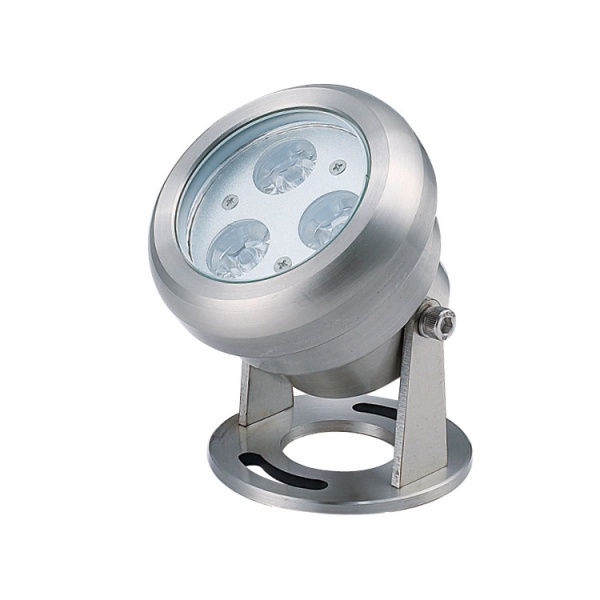
Fixed LED Underwater Lights
Fixed fixtures are suitable when the lighting direction is predetermined.
They can be used for:
Pond edges
Rocks
Plants
Small waterfalls
Adjustable Underwater Lights
Adjustable fixtures provide more flexibility.
The light head can be aimed toward:
Waterfalls
Trees
Sculptures
Rocks
Fountain jets
They are especially useful when the landscape design may change after installation.
Mini LED Underwater Lights
Mini underwater lights are suitable for smaller landscape ponds.
They can provide subtle lighting without visually dominating the landscape during the daytime.
Typical applications include:
Villa gardens
Small hotel ponds
Courtyard water features
Garden ponds
Decorative water features
How to Choose the Right Beam Angle for Pond Lighting?
Beam angle is one of the most important factors in underwater lighting design.
A narrow beam concentrates light into a smaller area, while a wider beam distributes light across a larger area.
For landscape ponds:
Narrow Beam
Suitable for:
Trees
Sculptures
Fountain jets
Specific architectural details
Medium Beam
Suitable for:
Rocks
Waterfalls
Medium-sized landscape features
Wide Beam
Suitable for:
Large water surfaces
Broad pond areas
General landscape illumination
For example, a narrow beam can create a dramatic highlight on one tree reflected in the water, while a wider beam can provide softer illumination across a large pond.
Beam-angle selection should be based on the distance from the fixture to the target and the desired visual effect. Narrow beams are commonly used to create focused accents in fountains, reflecting pools and ponds.
How to Position LED Underwater Lights in a Landscape Pond?
There are several common lighting positions.
1. Pond Edge Lighting
Fixtures are installed near the edge and aimed toward the center or selected features.
This can create:
Soft water illumination
Reflections
Landscape depth
2. Bottom Lighting
Fixtures are positioned on the pond floor and aimed upward.
This works well for:
Fountain jets
Water plants
Sculptures
Vertical features
However, installation depth and maintenance access must be considered.
3. Rock Lighting
Place underwater lights near rocks and aim them toward the surface.
This can highlight the natural texture of the rocks.
4. Waterfall Lighting
For waterfalls, position the fixtures so the light interacts with moving water.
The goal is usually to illuminate the water movement, rather than simply lighting the wall behind the waterfall.
5. Plant Lighting
Underwater lights can also be used to highlight aquatic plants.
For a natural landscape design, use lower-intensity lighting and avoid excessive brightness.
How Many Underwater Lights Does a Landscape Pond Need?
There is no universal number of fixtures for every pond.
The required quantity depends on:
Pond dimensions
Water depth
Fixture wattage
Beam angle
Mounting position
Desired brightness
Landscape features
Viewing distance
For example, a small residential pond may only require several low-power fixtures.
A large resort pond may require multiple lighting zones.
Instead of calculating lights only by pond area, consider the features that need to be highlighted.
For example:
3 lights → waterfall
4 lights → rocks
6 lights → pond perimeter
2 lights → sculpture
This feature-based approach can create a more controlled lighting design.
Should Landscape Ponds Use White or RGB Underwater Lights?
The answer depends on the project.
White LED Underwater Lights
White lighting is suitable for:
Hotels
Villas
Gardens
Luxury resorts
Natural landscape ponds
Warm white can create a relaxing atmosphere.
Neutral white can provide a cleaner architectural appearance.
RGB Underwater Lights
RGB is suitable when dynamic color effects are required.
It can create:
Blue
Green
Red
Purple
Cyan
Color-changing scenes
RGB underwater lights can be useful for:
Resort entertainment areas
Event venues
Commercial landscapes
Large fountains
Special events
RGBW Underwater Lights
RGBW adds a dedicated white LED channel.
This provides greater flexibility for projects that require both:
Everyday White Lighting
and
Dynamic Color Effects
For hotels and resorts, RGBW can be particularly useful because the same lighting system can support normal operation and special events.
How to Choose the Color Temperature for Landscape Ponds?
For natural landscape ponds, color temperature should complement the surrounding environment.
Warm White
Around 2700K–3000K
Suitable for:
Gardens
Villas
Hotels
Natural stone
Wooden architecture
Creates a warm and relaxing atmosphere.
Neutral White
Around 4000K
Suitable for:
Modern architecture
Commercial landscapes
Contemporary gardens
Creates a cleaner appearance.
RGB/RGBW
Suitable for:
Dynamic landscapes
Resorts
Entertainment areas
Events
The color should support the landscape rather than overpower it.
Why IP68 Matters for Landscape Pond Lighting
A landscape pond is a continuous wet environment.
A fixture that is only designed for rain or temporary splashing should not automatically be treated as suitable for permanent underwater installation.
For permanently submerged applications, designers commonly look for fixtures specifically designed and tested for immersion, often with an IP68 rating.
However, IP68 should not be treated as a universal statement that every fixture can be installed at any depth or under any water condition.
The manufacturer should provide the applicable test conditions and installation instructions.
IEC 60598-2-18:2022 specifically covers fixed luminaires intended for use in water or in contact with water, including fountains and garden pools.
This standard is therefore an important reference when selecting lighting equipment for water-feature applications.
DC24V Underwater Lights for Landscape Ponds
For many landscape lighting projects, DC24V underwater lights can be a practical low-voltage option when the selected fixture is designed for DC24V.
For example:
10 × 12W lights
Total power:
120W
At 24V:
120W ÷ 24V = 5A
For larger projects, however, cable length and voltage drop need to be considered.
As the distance between the power supply and underwater lights increases, cable resistance can cause voltage loss.
Therefore, large pond lighting systems may require:
Larger cable sizes
Shorter cable runs
Multiple circuits
Distributed power supplies
The exact electrical design should be calculated according to the fixture specifications and local regulations.
How to Avoid Voltage Drop in Pond Lighting?
Voltage drop is particularly important in DC24V systems.
Imagine a large resort pond with:
30 × 12W underwater lights
Total power:
360W
Current at DC24V:
360W ÷ 24V = 15A
If all fixtures are connected through a long cable run, the voltage at the farthest fixtures may be lower than at the beginning of the circuit.
This can result in:
Lower brightness
Uneven illumination
RGB color differences
Unstable operation
A better approach may be to divide the pond into multiple lighting zones.
For example:
Zone A → 10 lights
Zone B → 10 lights
Zone C → 10 lights
This can make power distribution easier to manage.
How to Use DMX512 for Landscape Pond Lighting?
DMX512 can be useful when a pond requires dynamic RGB or RGBW effects.
For example:
Zone 1
Waterfall
Zone 2
Pond perimeter
Zone 3
Fountain
Zone 4
Sculpture
Each zone can be programmed independently.
A DMX512 system can create:
Static colors
Color transitions
Fading
Color-changing scenes
Zone effects
Event lighting
For example:
Normal Mode
Warm white
↓
Evening Mode
Blue
↓
Event Mode
RGB color changing
↓
Late Night Mode
Low brightness
This gives hotel and resort operators greater flexibility.
How to Create Natural-Looking Pond Lighting?
One of the biggest mistakes in landscape pond lighting is using too much light.
A natural pond should not necessarily look like a brightly illuminated swimming pool.
Instead, try to create a balance between:
Light
and
Shadow
For example:
Bright
Waterfall
Medium
Rocks
Soft
Aquatic plants
Dark
Open water areas
This creates depth and visual contrast.
The goal is to make people notice the landscape rather than the lighting fixtures themselves.
Avoid Glare When Designing Pond Lighting
Glare can reduce the quality of a pond lighting installation.
If the fixture is visible from the main viewing position, the viewer may see the LED source directly rather than seeing the illuminated landscape.
To reduce glare:
Aim fixtures away from the main viewing direction
Use suitable beam angles
Use recessed or concealed mounting where appropriate
Position fixtures behind rocks or landscape elements
Avoid excessive brightness
For hotels and resorts, glare control is particularly important because guests may view the water feature from multiple directions.
Lighting Different Landscape Pond Features
H3: Rocks
Use directional light to highlight rock texture.
H3: Water Plants
Use softer light to avoid overpowering the plants.
H3: Waterfalls
Aim the light toward moving water.
H3: Fountain Jets
Use focused beams when a strong jet effect is required.
H3: Sculptures
Use narrow or medium beams depending on sculpture size.
H3: Open Water
Use wider beams and lower intensity for subtle illumination.
Stainless Steel Underwater Lights for Landscape Ponds
Material selection is also important.
Underwater fixtures may be exposed to:
Continuous moisture
Water treatment chemicals
Outdoor humidity
Temperature changes
Mineral deposits
Stainless steel housings can be suitable for many landscape water-feature applications.
For more demanding environments, the appropriate stainless-steel grade should be selected according to:
Water chemistry
Chlorine exposure
Salt exposure
Installation environment
The housing material should therefore be considered together with the lens, seals, cable and overall fixture construction.
Common Mistakes in Landscape Pond Lighting Design
Mistake 1: Using Too Many Lights
More lights do not automatically create better lighting.
Mistake 2: Choosing Only by Wattage
A 24W fixture with the wrong beam angle may perform worse than a correctly positioned 12W fixture.
Mistake 3: Ignoring Water Depth
Fixture installation depth should match the manufacturer's specifications.
Mistake 4: Ignoring Cable Length
Long DC24V cable runs can create voltage-drop problems.
Mistake 5: Using the Same Beam Angle Everywhere
Different landscape features often require different beam angles.
Mistake 6: Excessive Brightness
Over-lighting can destroy the natural appearance of the landscape.
Mistake 7: Ignoring Maintenance
A fixture that looks perfect on paper but is impossible to access can create problems later.
Landscape Pond Lighting Design Example
Consider a hotel garden pond.
Project
Pond Size:
20m × 8m
Water Depth:
1–1.5m
Main Features:
Rock landscape
Small waterfall
Aquatic plants
Decorative sculpture
Lighting Design
Waterfall
4 × narrow/medium beam underwater lights
Rocks
6 × medium beam underwater lights
Plants
4 × low-power underwater lights
Sculpture
2 × focused beam underwater lights
Control
RGBW + DMX512
Power
DC24V
Protection
IP68-rated fixture suitable for the specified underwater installation
This design creates several lighting layers rather than illuminating the entire pond uniformly.
Recommended Design Process for Landscape Pond Lighting
A professional pond lighting project can follow these steps.
Step 1 — Study the Pond
Measure:
Length
Width
Depth
Water features
Step 2 — Identify the Visual Focal Points
Mark:
Waterfalls
Rocks
Plants
Sculptures
Fountain jets
Step 3 — Select Fixture Types
Choose:
Fixed
Adjustable
Mini
High-power
Step 4 — Select Beam Angles
Match the beam angle to the target distance.
Step 5 — Select Color
Choose:
Warm white
Neutral white
RGB
RGBW
Step 6 — Select Electrical Configuration
Consider:
DC24V
Power supply capacity
Cable length
Voltage drop
Step 7 — Select Control
Choose:
ON/OFF
Remote control
DMX512
Step 8 — Test Before Final Installation
Test:
Brightness
Color
Beam angle
Glare
Uniformity
This can prevent expensive changes after the pond is completed.
Landscape Pond Lighting for Hotels, Resorts and Villas
LED underwater lighting can be used in many landscape environments.
Hotels
Entrance ponds
Courtyard water features
Decorative fountains
Water walls
Resorts
Garden ponds
Swimming pools
Large fountains
Waterfalls
Villas
Private garden ponds
Small fountains
Decorative water features
Commercial Landscapes
Public plazas
Shopping centers
Office complexes
Architectural landscapes
For large projects, lighting designers and contractors should evaluate the complete electrical and control system rather than selecting fixtures individually.
Always Lighting LED Underwater Lighting Solutions
Always Lighting provides LED lighting solutions for architectural and landscape applications, including LED underwater lights for ponds, fountains and water features.
Depending on project requirements, underwater lighting solutions can include:
DC24V
IP68
RGB
RGBW
DMX512
Stainless Steel Housing
Different wattages
Different beam angles
Custom cable lengths
For a landscape pond project, customers can provide:
Pond dimensions + water depth + lighting quantity + desired color + beam angle + cable length + control system.
This information allows the lighting supplier to recommend a more suitable configuration.
Conclusion
Designing underwater lighting for a landscape pond requires more than choosing a waterproof LED light.
A successful design should combine:
Pond Design
Fixture Position
Beam Angle
Wattage
Color Temperature
IP68 / Immersion Requirements
DC24V Power Distribution
RGB/RGBW
DMX512 Control
Maintenance Planning
The best landscape pond lighting is usually not the brightest lighting.
It is lighting that highlights the right features, controls glare, creates depth and works naturally with the surrounding landscape.
For hotels, resorts, villas and commercial landscape projects, a carefully designed LED underwater lighting system can turn a simple pond into a strong nighttime architectural and landscape feature.
FAQ
What type of LED underwater light is best for landscape ponds?
The right fixture depends on pond depth, target features, mounting position, beam angle and desired lighting effect. For permanently submerged applications, select a fixture specifically designed and tested for the intended immersion conditions.
Are IP68 LED underwater lights suitable for landscape ponds?
IP68-rated fixtures are commonly used for permanently submerged applications, but the exact IP68 test conditions should be checked with the manufacturer. The complete installation should also comply with applicable electrical and safety requirements. IEC 60598-2-18:2022 covers fixed luminaires used in or in contact with water, including garden pools and fountains.
What beam angle should I use for pond lighting?
Narrow beams are useful for highlighting fountains, sculptures and individual landscape features. Wider beams are more suitable for broader areas. The correct beam angle depends on the fixture-to-target distance and desired effect.
Should I use RGB or white underwater lights for a landscape pond?
Warm white is usually suitable for natural and luxury landscape environments. RGB or RGBW is better when dynamic color-changing effects are required.
Are DC24V underwater lights suitable for landscape ponds?
Yes, when the fixture is specifically designed for DC24V and the complete electrical system is correctly designed. Cable length, current and voltage drop should be considered for larger installations.
Can DMX512 control pond underwater lights?
Yes, compatible RGB or RGBW underwater lights can be controlled using DMX512 for color, brightness and dynamic lighting scenes.
How many underwater lights does a pond need?
There is no fixed number. Fixture quantity depends on pond size, water depth, lighting targets, beam angle, wattage and desired visual effect.
How can I reduce glare from underwater pond lights?
Position fixtures away from the main viewing direction, use appropriate beam angles and conceal or shield fixtures where possible.
Is stainless steel good for underwater pond lights?
Stainless steel can be a suitable housing material for many underwater applications. The appropriate material grade should be selected according to water chemistry and the actual installation environment.
What information is needed to design pond underwater lighting?
Provide the pond dimensions, water depth, photos or drawings, waterfall/fountain locations, desired color, beam angle, quantity, cable length and control requirements.
Related Application
https://www.always-lighting.com/Applications/landscape-underwater-lighting-solutions/