
- 15 Oct 2026
LED Cabinet Light vs LED Strip Light: Which Is Better?
LED Cabinet Light vs LED Strip Light: Which Is Better for Display Cabinets?
Choosing between an LED cabinet light and an LED strip light is an important decision when designing display cabinets for jewelry stores, retail shops, museums, and commercial showrooms.
Both options can provide effective illumination, but they are not the same. Purpose-built LED cabinet lights are designed for specific cabinet lighting applications, while LED strip lights offer flexibility for custom layouts and concealed installations.
The best choice depends on the cabinet structure, desired lighting effect, installation space, color rendering requirements, power supply, maintenance needs, and project budget.
For display cabinets that require repeatable lighting performance and a planned mounting arrangement, a purpose-built LED cabinet light is often worth considering. LED strip lights can be suitable for flexible, concealed, or customized lighting layouts. For jewelry showcases, a combination of linear cabinet lights and accent spotlights may provide the most appropriate result.
This guide compares both options to help display cabinet manufacturers, jewelry retailers, wholesalers, and lighting project contractors make an informed decision.
1. What Is an LED Cabinet Light?
An LED cabinet light is a lighting fixture designed for installation in display cabinets, glass showcases, retail shelves, and other display furniture.
Unlike a flexible LED strip, a purpose-built cabinet light may use a rigid housing, integrated optical components, and a defined mounting arrangement. However, cabinet lighting is a broad product category that also includes small spotlights and integrated gantry lighting.
Common types include the following.
LED Cabinet Linear Light
A linear LED cabinet light illuminates a longer section of a cabinet or shelf. Depending on its optical design and installation position, it can provide relatively continuous illumination across the display area.
Typical applications include jewelry counters, glass display cases, retail shelving, and showcase interiors.
Explore Always Lighting LED Cabinet Linear Light for product details.
LED Showcase Spotlight
A showcase spotlight produces a more focused beam that can highlight individual items or selected display areas.
It can be useful for jewelry, watches, gemstones, and premium merchandise that benefits from focused accent lighting.
See LED Showcase Spotlight for a dedicated display lighting option.
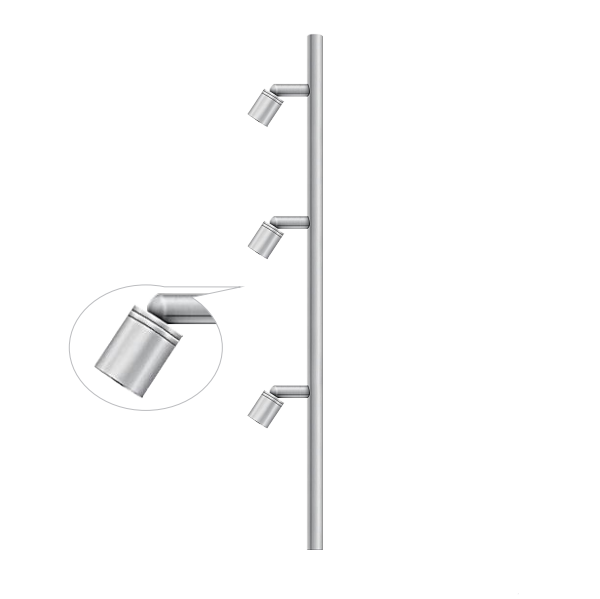
LED Showcase Gantry Light
A gantry light can be integrated with a showcase frame or supporting structure, depending on the product design.
This approach may suit display cabinet manufacturers who want to coordinate the lighting fixture, cabinet dimensions, mounting positions, and wiring during production.
Explore LED Showcase Gantry Light for integrated showcase lighting applications.
2. What Is an LED Strip Light?
An LED strip light is a flexible circuit board with multiple LED chips mounted along its length. It is commonly installed along cabinet edges, underneath shelves, inside grooves, or in concealed locations.
LED strip lights are available in different power ratings, color temperatures, LED densities, lengths, and color-rendering specifications.
For display cabinet applications, strip lighting may be installed directly onto a suitable mounting surface or inside an aluminum profile with a diffuser.
Advantages of LED Strip Lights
LED strip lights offer several advantages:
Flexible installation: The strip can follow suitable straight or curved cabinet layouts, subject to the product's bending limitations.
Compact dimensions: Thin strips can fit into narrow spaces where a larger fixture may not fit.
Custom lengths: The strip can often be cut at designated points, according to the manufacturer's instructions.
Concealed lighting: Strips can be hidden behind cabinet edges or inside grooves to create a discreet lighting effect.
Custom projects: They can be useful when a cabinet design requires a non-standard lighting arrangement.
However, the performance of an LED strip depends on its LED density, optical design, installation surface, power supply, thermal management, and accessories.
A bare strip does not automatically provide the same mechanical protection, light distribution, or installation convenience as a purpose-built cabinet fixture.
3. LED Cabinet Light vs LED Strip Light: Key Differences
The main difference is not simply brightness. Buyers should compare the complete lighting system, including the fixture, installation components, electrical requirements, and maintenance arrangements.
| Comparison Factor | Purpose-Built LED Cabinet Light | LED Strip Light |
|---|---|---|
| Product design | Often supplied as a dedicated lighting fixture | Flexible LED circuit board |
| Installation | Uses the model's specified mounting method | Often requires a suitable mounting surface or profile |
| Light distribution | Depends on the fixture's optical design | Depends on LED arrangement, strip design, profile, and diffuser |
| Installation flexibility | Depends on fixture dimensions and mounting options | Often offers greater flexibility for custom layouts |
| Mechanical protection | Depends on the housing and product construction | Depends on the strip coating, profile, and installation environment |
| Heat management | Depends on the fixture design and mounting conditions | Requires attention to the strip's mounting surface and thermal conditions |
| Maintenance | May allow replacement of the complete fixture or serviceable components | May require replacing a strip section and checking connections |
| Project cost | Depends on the fixture, installation, and accessories | Strip material may cost less, but profiles, drivers, wiring, and labor add to the system cost |
| Best use case | Planned, repeatable cabinet lighting installations | Flexible, concealed, or customized lighting layouts |
Important: These differences are general design considerations, not universal performance guarantees. A well-designed strip lighting system can perform very well, while an unsuitable cabinet fixture can produce poor lighting. Compare actual specifications and test the intended installation before making a final decision.
4. Which Is Better for Jewelry Display Cabinets?
Jewelry display cabinets require careful lighting because the merchandise often includes reflective metals, gemstones, polished surfaces, and glass panels.
The lighting must illuminate the products while controlling glare, reflections, and uneven brightness.
When to Choose an LED Cabinet Light
A purpose-built cabinet light may be the better option when:
The cabinet requires a defined fixture size and mounting arrangement.
Multiple showcases must use consistent lighting specifications.
The project needs a planned light distribution pattern.
The cabinet manufacturer wants to coordinate lighting installation with cabinet production.
The project requires documented product specifications and a repeatable procurement process.
For jewelry counters, linear cabinet lights can illuminate longer display sections, while dedicated showcase spotlights can provide accent lighting for selected products.
When to Choose an LED Strip Light
LED strip lighting may be suitable when:
The cabinet has narrow grooves or concealed mounting spaces.
Flexible or customized installation is important.
The objective is to provide subtle illumination along cabinet edges.
The design requires a continuous lighting line following a suitable cabinet profile.
The project allows the installer to select compatible profiles, diffusers, drivers, and accessories.
For jewelry displays, confirm the actual color-rendering performance and test the completed installation with the merchandise. Strip lighting should not be selected on the basis of flexibility or price alone.
Can You Combine LED Cabinet Lights and LED Strip Lights?
Yes. A hybrid arrangement may be useful when different parts of the cabinet require different lighting effects.
For example, a purpose-built linear cabinet light may illuminate the main display area, while a concealed LED strip provides supplementary illumination along a cabinet edge.
If individual products require stronger emphasis, suitable showcase spotlights may also be considered.
The final combination should be evaluated for illumination uniformity, reflections, brightness balance, wiring complexity, and maintenance access.
5. Compare CRI and Color Temperature Before Buying
Color rendering index (CRI) and correlated color temperature (CCT) are important when comparing cabinet lighting products.
Neither specification should be overlooked simply because one lighting option is easier to install.
CRI: How Accurately Does the Light Render Colors?
CRI describes how a light source renders colors compared with a reference light source under specified conditions.
For jewelry, watches, cosmetics, and other color-sensitive merchandise, the actual CRI specification matters.
When comparing an LED cabinet light with an LED strip light:
Check the manufacturer's verified CRI data.
Confirm whether the strip or fixture has the required color-rendering performance.
Consider additional color-rendering information, such as R9, when the application requires it.
Test the light with the actual products before ordering in bulk.
Do not assume that every purpose-built cabinet light has a higher CRI than every LED strip. The result depends on the specific light source and product design.
CCT: Warm White, Neutral White, or Cool White?
Common color temperatures include 3000K, 4000K, and 6000K.
3000K: Produces a warm-white appearance and may suit selected gold jewelry displays and warm retail interiors.
4000K: Produces a more neutral-white appearance and may suit mixed merchandise or contemporary retail designs.
6000K: Produces a cooler-white appearance and may suit certain display preferences.
These are starting points, not universal rules. The best choice depends on the merchandise, interior design, surrounding light, and desired visual appearance.
Compare the cabinet light and strip light at the same color temperature whenever possible. This makes it easier to assess differences in brightness, color appearance, and uniformity.
6. Consider Brightness, Light Distribution, and Glare
A common purchasing mistake is comparing only wattage.
Wattage measures electrical power consumption, not the complete lighting performance. Two products with the same wattage may produce different illumination because of their luminous output, optical design, installation position, and beam distribution.
When selecting display cabinet lighting, consider the following factors.
Brightness and Illuminance
Luminous flux, measured in lumens, describes the amount of visible light emitted by a source. Illuminance, measured in lux, describes the light incident on a surface.
For display cabinets, the relevant question is not simply how many watts the fixture consumes, but how much useful light reaches the merchandise and whether the distribution is appropriate.
Light Uniformity
Linear cabinet fixtures may be suitable for illuminating a longer shelf or display section.
LED strips may also create a continuous lighting line, especially when installed with a suitable profile and diffuser.
However, visible LED points, gaps, or dark areas can occur depending on LED density, diffuser design, mounting distance, and cabinet geometry.
Always evaluate the actual lighting arrangement rather than assuming either solution automatically produces uniform illumination.
Glare and Glass Reflections
Glass showcases can reflect the light source and surrounding fixtures. Excessive brightness or poorly planned fixture positioning may make the merchandise difficult to see.
To reduce glare:
Position the fixtures according to the cabinet structure and customer viewing angles.
Test the display from the normal viewing position.
Avoid unnecessary overlapping bright spots.
Consider a suitable diffuser or optical design.
Adjust the fixture position before increasing brightness.
For large retail projects, a sample cabinet or mock-up can help reveal problems before the lighting specification is repeated throughout the store.
7. Check Installation, Power Supply, and Heat Management
The installation requirements can make a significant difference to the total cost and long-term practicality of a cabinet lighting system.
Installation and Accessories
Purpose-built cabinet lights may come with a defined mounting arrangement, while LED strips may require additional accessories.
Depending on the product, the strip system may need:
An aluminum mounting profile.
A compatible diffuser.
A suitable power supply or driver.
Connectors, wiring, and mounting accessories.
Appropriate cable routing and maintenance access.
Include these items when comparing quotations rather than comparing the cost of a cabinet fixture with the cost of strip material alone.
Power Supply and Voltage Drop
Confirm the required input voltage and the compatible driver or power supply.
For longer strip runs or multiple cabinet sections, calculate the connected load and check voltage drop, cable dimensions, power-feed positions, and the manufacturer's maximum permitted run length.
The same principle applies to multi-fixture cabinet systems: the actual electrical configuration must match the selected product specifications.
Heat Dissipation
LEDs generate heat during operation. Excessive temperature can affect reliability and performance.
Follow the manufacturer's installation instructions, use compatible mounting components, and provide suitable heat dissipation.
For strip lights, an appropriate aluminum profile may help with heat transfer, depending on the strip's power density and the profile design. A profile should not be assumed to solve every thermal problem automatically.
Maintenance and Replacement
Consider how the fixture or strip will be accessed if it needs repair or replacement.
For retail projects with many cabinets, maintenance access can affect service time and operational disruption. Plan wiring and mounting positions before the cabinet enters production.
8. Which Option Offers Better Value for Bulk Projects?
For display cabinet manufacturers, wholesalers, importers, and retail fit-out contractors, the lowest initial component price does not always produce the lowest total project cost.
A useful comparison includes the full installed system.
| Cost Factor | What to Check |
|---|---|
| Fixture or strip price | Unit price and required quantity |
| Accessories | Profiles, diffusers, connectors, and mounting parts |
| Power supply | Required capacity, quantity, and compatibility |
| Installation labor | Cutting, routing, mounting, wiring, and testing |
| Consistency | Ability to reproduce the same lighting arrangement across cabinets |
| Maintenance | Accessibility and replacement requirements |
| Customization | Tooling, dimensions, finish, or special electrical requirements |
| Documentation | Datasheets, installation instructions, and warranty conditions |
A purpose-built LED cabinet light may be worthwhile when installation repeatability and defined product specifications are priorities.
An LED strip system may offer good value when flexible routing and concealed installation are essential.
For large orders, request a quotation based on the complete configuration. Compare the fixture, accessories, electrical components, installation effort, and maintenance requirements together.
9. How to Choose the Right Lighting for Your Display Cabinet
Use the following checklist before requesting samples or confirming a bulk order.
Step 1: Define the application.
Identify whether the cabinet will display jewelry, watches, cosmetics, museum objects, or general retail products.
Step 2: Measure the cabinet.
Record the length, depth, height, available mounting space, and wiring routes. Provide drawings or photographs if possible.
Step 3: Decide on the lighting effect.
Determine whether you need continuous illumination, focused accent lighting, concealed edge lighting, or a combination.
Step 4: Confirm the technical requirements.
Check CRI, CCT, luminous output, light distribution, input voltage, driver compatibility, and mounting details.
Step 5: Compare the complete installed cost.
Include required accessories, wiring, power supplies, assembly, and maintenance.
Step 6: Test a sample.
For customized cabinets and multi-store retail projects, evaluate the light with actual merchandise before standardizing the specification.
Step 7: Document the final configuration.
Record the model number, technical specifications, installation arrangement, and approved lighting appearance for repeat orders.
10. LED Cabinet Lighting Solutions for B2B Buyers
Always Lighting provides LED lighting options for jewelry showcases, display cabinets, retail shelves, and commercial display applications.
Depending on the project requirements and selected models, buyers can evaluate:
LED cabinet linear lights for longer display sections.
LED showcase spotlights for focused product illumination.
LED showcase gantry lights for integrated showcase structures.
The appropriate option depends on cabinet dimensions, merchandise, lighting effect, and electrical requirements.
For display cabinet manufacturers, wholesalers, jewelry retailers, and retail contractors, discussing these factors before placing an order helps reduce specification mismatches and unnecessary installation changes.
Explore the Always Lighting Display Cabinet Lighting range to compare available product options.
Frequently Asked Questions
1. Is an LED cabinet light better than an LED strip light?
Neither option is universally better. Purpose-built cabinet lights may suit planned installations with defined mounting and optical requirements, while LED strips are useful for flexible and concealed layouts. The best choice depends on the application, installation, lighting quality, and total project cost.
2. Can LED strip lights be used inside glass display cabinets?
Yes. LED strip lights can be installed inside suitable display cabinets, often along edges, shelves, or concealed profiles. Confirm the strip's electrical specifications, light distribution, heat management, and mounting requirements before installation.
3. Which is better for jewelry showcases: linear lights or LED strips?
Both can be suitable. Linear cabinet lights may be preferable when a defined fixture and repeatable installation are needed. LED strips may work well for concealed or custom layouts. For jewelry displays, compare CRI, color temperature, glare, and the actual appearance of the merchandise.
4. Do LED cabinet lights produce more uniform illumination than LED strips?
Not automatically. Uniformity depends on the LED arrangement, optical design, diffuser, mounting distance, fixture spacing, and cabinet geometry. A properly designed strip system can provide continuous illumination, while an unsuitable fixture layout can still produce dark areas.
5. Do LED strip lights need an aluminum profile?
Not every strip installation requires the same type of profile, but an appropriate aluminum profile can provide mechanical support, a mounting surface, and heat transfer. It may also accept a diffuser. The correct arrangement depends on the strip's specifications, power density, and installation conditions.
6. What should I compare when requesting quotations?
Compare the complete specification, including model, dimensions, CRI, CCT, luminous output, voltage, driver, mounting accessories, installation requirements, warranty, and total system price. For a bulk order, also confirm sample approval and consistency between production batches.
7. Can LED cabinet lights and LED strips be used together?
Yes. A hybrid lighting layout may combine linear cabinet lights for general illumination with LED strips for concealed supplementary lighting. Showcase spotlights can also be used for accent lighting. Ensure that the combined arrangement controls glare and provides an appropriate balance of brightness.
8. What information should I provide to an LED cabinet lighting supplier?
Provide cabinet drawings or dimensions, the intended application, required quantity, preferred CCT and CRI, mounting details, input voltage, power requirements, and any customization needs. Photographs of the cabinet and merchandise can help clarify the desired lighting effect.
Conclusion: Choose the Lighting System That Fits the Cabinet
LED cabinet lights and LED strip lights both have a role in display cabinet lighting. The right solution depends on the cabinet structure, desired light distribution, merchandise, electrical arrangement, installation requirements, and total cost.
For jewelry showcases and repeatable commercial installations, purpose-built cabinet lights are worth evaluating. For concealed lighting and customized cabinet geometry, LED strips can offer useful flexibility. In some applications, combining different lighting types provides a better result than using either one alone.
Looking for LED cabinet lighting for your next project?
Contact Always Lighting with your cabinet dimensions, product requirements, estimated quantity, and preferred lighting effect. Our team can help you review suitable product options and confirm the relevant technical specifications for your project.
Explore Display Cabinet Lighting | Contact Always Lighting