
- 15 Oct 2026
How to Reduce Glare and Reflections in Glass Display Cabinets
How to Reduce Glare and Reflections in Glass Display Cabinets
Glare and reflections are common challenges in glass display cabinet lighting, particularly in jewelry stores, luxury retail shops, watch boutiques, museums, and commercial showrooms.
Even when a display cabinet has powerful LED lights, customers may struggle to see the merchandise clearly if the light sources are reflected in the glass. Bright spots on polished gold, diamonds, and other reflective products can also distract from the display.
The most effective way to reduce glare and reflections in glass display cabinets is to coordinate the lighting position, beam direction, brightness, glass configuration, and customer viewing angles. Simply installing brighter lights or replacing every fixture will not necessarily solve the problem.
For jewelry retailers, display cabinet manufacturers, lighting wholesalers, and retail fit-out contractors, a well-planned lighting arrangement can improve product visibility while maintaining the desired visual presentation.
This guide explains the common causes of glare, practical ways to reduce reflections, and how to choose LED cabinet lights for glass showcases.
1. What Causes Glare and Reflections in Glass Display Cabinets?
Before changing the lighting system, identify the source of the problem. Glare and reflections are related, but they are not exactly the same.
Reflections from Glass Surfaces
Glass can reflect light sources, windows, ceiling lights, neighboring displays, and people standing near the cabinet.
These reflections can overlap with the merchandise and make small details difficult to see.
For example, a customer examining a diamond ring may see the reflection of a bright ceiling spotlight in the front glass rather than a clear view of the ring.
Direct Glare from Light Sources
Direct glare occurs when a light source is excessively bright in the viewer's field of vision.
A spotlight installed at an unsuitable angle may be visible to customers while they look into the cabinet.
This can make the viewing experience uncomfortable even when the merchandise itself is illuminated adequately.
Bright Spots on Jewelry and Polished Surfaces
Gold, silver, diamonds, watches, and other polished products reflect light differently from matte surfaces.
Some small, bright reflections on jewelry can be visually desirable. The problem occurs when excessive brightness, distracting hotspots, or large reflected areas make the merchandise difficult to examine.
Uneven Brightness Inside the Cabinet
A cabinet with very bright spots and dark surrounding areas can create an unbalanced display.
This may occur when fixtures are positioned too close to the products, beam angles are unsuitable, or several spotlights overlap in the wrong places.
External Lighting and Windows
Reflections may also come from outside the cabinet.
Windows, ceiling fixtures, track lights, illuminated signs, and neighboring showcases can all contribute to reflections on the glass.
The first step is to identify whether the problem comes from the cabinet lights, surrounding lighting, the glass itself, or a combination of these factors.
2. Position LED Cabinet Lights According to Customer Viewing Angles
Light positioning is one of the most important ways to reduce reflections in a glass showcase.
A fixture can illuminate the merchandise effectively but still create distracting reflections if it is placed directly in a reflective path between the glass and the customer's eyes.
Check Where Customers Stand
Before finalizing the fixture positions, identify the normal viewing locations.
For a jewelry counter, consider customers standing in front of the cabinet and staff members viewing the products from behind the counter.
For a freestanding showcase, consider viewing angles from multiple sides.
The reflection pattern changes with the relative positions of the light source, glass, merchandise, and observer.
Move or Re-Aim Fixtures
If a bright fixture is reflected in the glass, try changing its position or aiming direction.
Depending on the cabinet design, possible adjustments include:
Moving the light farther from the front glass.
Positioning the fixture along an appropriate cabinet edge.
Changing the aiming angle of a spotlight.
Using a suitable shield or optical accessory to limit light outside the intended target area.
Relocating an external light source that is reflected directly in the display.
The correct adjustment depends on the cabinet geometry and the available mounting positions.
Test from the Actual Viewing Position
Do not evaluate the lighting only while standing beside the cabinet during installation.
Step into the customer's normal viewing position and check whether the light sources are visible in the glass.
Test from several positions because a setup that works from one angle may still create reflections from another.
3. Choose the Right Type of LED Cabinet Light
Different fixture designs distribute light differently. Selecting a suitable light source can help reduce distracting bright spots when it is combined with proper positioning.
Two common options for jewelry showcases are linear LED cabinet lights and mini LED spotlights.
Linear LED Cabinet Light
A linear LED cabinet light distributes illumination along a longer section of a cabinet or shelf.
It may be suitable for jewelry counters, display shelves, and glass showcases that require continuous general illumination.
When properly selected and positioned, linear lighting can reduce reliance on multiple individual point sources along a display section.
However, a linear light can still produce reflections if its position, brightness, or orientation is unsuitable.
Explore Always Lighting LED Cabinet Linear Light for product details.
Mini LED Cabinet Spotlight
A mini LED spotlight directs light toward a smaller target area.
It can be useful for highlighting rings, necklaces, watches, or selected products within a larger display.
However, a spotlight can create a concentrated bright spot or a reflection in the glass when its beam is aimed incorrectly.
To improve the result, evaluate the beam angle, installation depth, target distance, and aiming position together.
Explore Always Lighting 1W Recessed LED Cabinet Spotlight for a compact spotlight option.
Should You Combine Linear Lights and Spotlights?
A combined arrangement may be useful when the cabinet requires both general illumination and focused accent lighting.
For example, a linear cabinet light can illuminate a row of jewelry, while mini spotlights add emphasis to selected products.
The layout should be tested for overlapping beams, brightness imbalance, and reflections on the front glass before the fixtures are installed throughout a store.
4. Select the Correct Beam Angle and Lighting Direction
Beam angle affects how light spreads from a fixture and how much of the cabinet or merchandise is illuminated.
A narrow beam concentrates light into a smaller area, while a wider beam distributes light over a broader area under comparable conditions.
Neither option is automatically better for glare control.
When to Use a Narrower Beam
A narrower beam may be appropriate when the objective is to illuminate a selected piece of jewelry or a particular display area.
However, a narrowly focused beam can produce a strong hotspot if it is too intense or positioned too close to the merchandise.
When to Use a Wider Beam
A wider beam may be suitable for general cabinet illumination or for covering a larger display area.
Its effectiveness depends on fixture output, mounting position, cabinet dimensions, and the reflectivity of the glass and products.
Check the Direction of Reflected Light
When adjusting a fixture, evaluate where the light travels after it reaches the glass or a polished surface.
If the reflected image of the light source overlaps with the merchandise from the customer's viewing position, change the geometry where possible.
For larger displays, test several candidate positions before confirming the final arrangement.
The objective is to illuminate the products while preventing unnecessary light from reaching the viewer directly or creating distracting reflections in the glass.
5. Balance Brightness Inside and Outside the Cabinet
Increasing brightness is not always the best way to make a display easier to see.
If the cabinet interior is too dark relative to bright surroundings, reflections from the external environment can become more noticeable.
Conversely, excessive brightness inside the cabinet may create hotspots on glass and polished jewelry.
Avoid Excessive Brightness
Use a suitable lighting level for the merchandise and viewing conditions.
Where compatible dimming is available, adjust the output to find a comfortable balance between product visibility and glare.
For products with multiple lighting zones, consider whether each zone requires the same output.
Review the Surrounding Store Lighting
Check the cabinet together with its ambient lighting.
Ceiling lights, track lights, illuminated signs, and nearby showcases may contribute to reflected images on the front glass.
Adjusting the surrounding lighting or moving a reflected source may be more effective than changing the cabinet light itself.
Maintain Appropriate Contrast
The goal is to make the merchandise clearly visible without creating unnecessary differences between very bright spots and dark areas.
Evaluate the overall scene from the customer's viewing position rather than judging each fixture in isolation.
6. Use Diffusers, Shields, and Suitable Fixture Optics
The optical design of a lighting fixture affects how light is distributed and whether individual LED points or exposed light sources are visible.
Depending on the application, suitable accessories may help improve the visual result.
Diffusers for Linear Lighting
A compatible diffuser can soften the appearance of individual LED points and create a more continuous luminous surface.
However, a diffuser can also reduce light output. Its effect should therefore be evaluated together with the required illumination and the fixture specifications.
Shields and Glare-Control Accessories
A suitable shield, baffle, or optical accessory can limit unwanted light outside the intended area.
This can be useful when a fixture is visible from the customer's normal viewing angle.
The accessory must be compatible with the fixture and should not interfere with heat dissipation, electrical safety, or the manufacturer's installation requirements.
Choose Appropriate Optical Design
When comparing cabinet lights, ask the supplier about beam angle, light distribution, diffuser options, and any available photometric data.
Do not assume that a product described as a spotlight or a linear light will automatically be glare-free.
The final outcome depends on the complete lighting arrangement.
7. Consider the Glass Type and Cabinet Construction
Lighting adjustments should be evaluated before replacing the cabinet glass, but the glass specification can also influence reflections.
Review Glass Angle and Orientation
The glass angle and the surrounding structure affect the paths of reflected light.
Where cabinet design permits, review whether the glass orientation and viewing geometry can be adjusted to reduce distracting reflections.
Any changes must preserve the cabinet's structural requirements, appearance, and safety.
Consider Anti-Reflective Glass
Anti-reflective glass may help reduce visible reflections in applications where glass reflections remain a significant problem.
However, it may increase project cost and should not be treated as a substitute for proper lighting design.
If a bright fixture is positioned directly in a problematic reflective path, changing the lighting position may still be necessary.
Plan Lighting During Cabinet Production
For display cabinet manufacturers, it is often easier to coordinate light mounting positions, wiring routes, glass dimensions, and maintenance access during the design stage.
Before mass production, confirm the fixture dimensions and install a sample in a representative cabinet section.
This helps identify problems before they are repeated across multiple cabinets.
8. How to Reduce Glare in Jewelry, Watch, and Retail Display Cabinets
Different merchandise requires different lighting arrangements.
| Display Application | Common Lighting Challenge | Practical Approach |
|---|---|---|
| Gold jewelry showcases | Reflections from polished gold and front glass | Adjust fixture position, brightness, and viewing geometry |
| Diamond showcases | Concentrated bright spots and reflections | Evaluate spotlight aiming, beam angle, and overall contrast |
| Watch display cabinets | Reflections from glass, watch crystals, and metal cases | Check multiple viewing angles and avoid poorly aimed fixtures |
| Cosmetics displays | Glare on glossy packaging and glass shelves | Test fixture positions and consider appropriate diffusion |
| Museum display cases | Reflections that obscure artifacts and labels | Coordinate lighting with case design, ambient light, and viewing locations |
| Retail shelving | Bright points, uneven illumination, or visible LED sources | Compare linear lighting, suitable profiles, and fixture spacing |
These are general design considerations. The appropriate solution depends on the cabinet structure, merchandise, and lighting products.
For jewelry and other reflective objects, some small highlights may contribute to the desired presentation. The objective is to remove distracting reflections that prevent customers from seeing the merchandise clearly.
9. A Practical Glare-Reduction Checklist Before Installation
For jewelry retailers, display cabinet manufacturers, wholesalers, and fit-out contractors, the following process helps reduce the risk of costly changes after installation.
Step 1: Identify the reflection source.
Determine whether the reflection comes from a cabinet light, ceiling fixture, window, neighboring display, or the merchandise itself.
Step 2: Map customer viewing positions.
Check reflections from the normal standing and seated viewing positions, where relevant.
Step 3: Adjust the fixture position.
Move or re-aim fixtures where possible to reduce reflected images and direct glare.
Step 4: Review the optical design.
Check beam angle, light distribution, diffusers, and compatible glare-control accessories.
Step 5: Balance the brightness.
Evaluate cabinet lighting and surrounding ambient light together. Avoid solving every visibility problem by simply increasing output.
Step 6: Test the actual merchandise.
Reflective gold, diamonds, watches, and glass can produce different visual effects. Use the products that will actually be displayed.
Step 7: Inspect the completed cabinet.
Check reflections from several viewing positions and confirm that the lighting remains appropriate across the full display area.
Step 8: Approve a mock-up before bulk production.
For customized showcases and multi-store projects, test a representative cabinet section before standardizing the lighting arrangement.
10. Why Sample Testing Is Important for B2B Display Lighting Projects
Product datasheets are useful for checking electrical ratings, dimensions, beam angles, and color-rendering specifications. However, they cannot fully predict every reflection that may occur in a particular cabinet.
The result depends on the relative positions of the fixture, glass, merchandise, surrounding light sources, and customer.
For this reason, sample testing is particularly valuable for:
Jewelry showcase manufacturers.
Gold shop chains and multi-store retail projects.
Watch and luxury accessory retailers.
Commercial display cabinet suppliers.
Projects involving customized glass cabinets.
Retail fit-out contractors responsible for complete lighting installations.
A practical sample test can compare alternative mounting positions, linear lights and spotlights, different beam angles, and compatible glare-control accessories.
Record the approved fixture models, installation dimensions, CCT, brightness settings, and wiring configuration so the same arrangement can be reproduced during mass production.
11. LED Cabinet Lighting Solutions from Always Lighting
Always Lighting provides LED cabinet lighting options for jewelry showcases, retail displays, and commercial display applications.
Depending on the selected model and project requirements, buyers can evaluate:
LED Cabinet Linear Lights
Suitable for consideration when a display requires illumination along a longer shelf or cabinet section.
Product page: LED Cabinet Linear Light.
Mini LED Cabinet Spotlights
Suitable for consideration when selected products need focused accent lighting.
Product page: 1W Recessed LED Cabinet Spotlight.
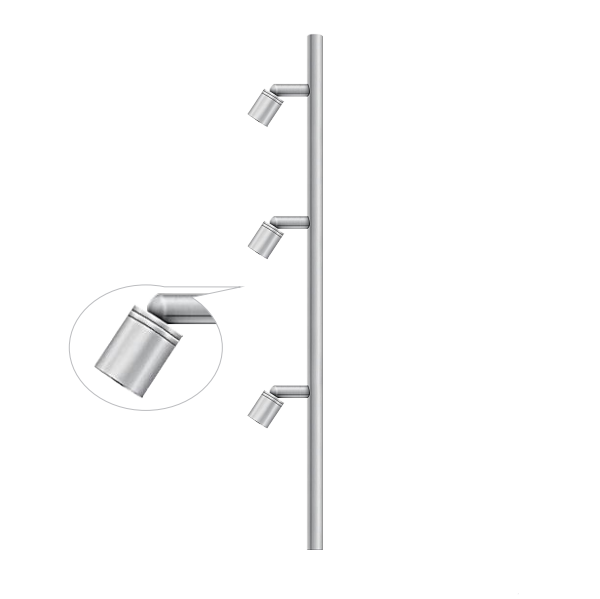
Integrated Showcase Lighting
Gantry lighting may be suitable for cabinet designs that integrate illumination with a supporting showcase structure.
Product page: LED Showcase Gantry Light.
The most appropriate product depends on the cabinet dimensions, mounting arrangement, merchandise, light distribution requirements, and electrical specifications. No fixture should be assumed to eliminate glare without evaluating its installation.
For project inquiries, buyers can provide cabinet drawings, photographs, dimensions, target products, required quantities, and preferred lighting effects.
Explore the complete Display Cabinet Lighting range or contact Always Lighting to discuss the technical requirements.
Frequently Asked Questions
1. How do you reduce glare in glass display cabinets?
Start by identifying the reflection source. Adjust the light position and aiming direction, review beam angles, balance the cabinet and ambient lighting, and test from the customer's normal viewing position. Diffusers, shields, or anti-reflective glass may help in specific situations.
2. Why do LED lights reflect in glass display cases?
Glass reflects light from the cabinet's internal fixtures as well as external sources such as windows, ceiling lights, and neighboring displays. The visibility of a reflection depends on the light source, glass configuration, viewing angle, and relative brightness.
3. Are linear LED cabinet lights better than spotlights for reducing reflections?
Not automatically. Linear lights distribute illumination along a longer section, while spotlights direct light toward a smaller area. A properly positioned linear light may reduce reliance on multiple visible bright points, but either fixture type can create reflections if installed incorrectly.
4. What beam angle is best for glass display cabinet lighting?
There is no universally best beam angle. A wider beam may suit general illumination, while a narrower beam can highlight selected products. The correct selection depends on the fixture position, cabinet dimensions, target distance, and desired distribution.
5. Does a diffuser eliminate glare?
A suitable diffuser can soften the appearance of individual LED points and improve light distribution, but it does not eliminate every source of glare or glass reflection. Its effectiveness depends on the lighting arrangement, diffuser design, and installation position.
6. Will anti-reflective glass solve jewelry showcase glare?
Anti-reflective glass may reduce visible reflections, but it does not replace correct fixture positioning and brightness control. Evaluate the lighting arrangement first and consider the glass specification as part of the complete cabinet design.
7. How can I reduce reflections in a jewelry showcase without replacing the lights?
First, try adjusting the existing fixture positions, aiming directions, and brightness settings where possible. Also review external light sources and the customer's viewing angles. These adjustments may improve the result without requiring a complete lighting replacement.
8. What information should I provide when requesting display cabinet lighting?
Provide the cabinet dimensions or drawings, glass configuration, type of merchandise, existing light positions, input voltage, required quantities, and photographs showing the reflections. This information helps a supplier understand the application and identify suitable products for evaluation.
Conclusion: Improve Visibility Through Better Lighting Design
Glare and reflections in glass display cabinets are usually best addressed by considering the entire lighting arrangement rather than increasing brightness or changing a single specification.
Fixture position, beam angle, light distribution, ambient brightness, glass configuration, and customer viewing angles all influence the result.
For jewelry showcases, retail counters, and commercial display cases, linear cabinet lights and mini spotlights can both be useful when selected and positioned appropriately. Sample testing helps confirm whether the finished cabinet provides clear product visibility and the intended presentation.
Looking for LED cabinet lighting for your display cabinet project?
Contact Always Lighting with your cabinet drawings, photographs, dimensions, and lighting requirements to discuss suitable linear cabinet lights, mini spotlights, and other display lighting options.
Explore Display Cabinet Lighting | Contact Always Lighting