
- 31 Jul 2026
How to Prevent Light Pollution in Landmark Facade Lighting | Always Lighting
How to Prevent Light Pollution in Landmark Facade Lighting
Cultural landmarks and historic facades are the proud signatures of a city's nightscape. However, overly intense or poorly targeted illumination often leads to light pollution—including light trespass, skyglow, and uncomfortable glare.
Preventing light pollution in landmark facade lighting requires a combination of precise optical engineering, anti-glare accessories, accurate tilt positioning, and automated DMX control systems. By directing light strictly onto the architectural target, lighting engineers can achieve striking night aesthetics while protecting the dark sky and neighboring urban areas.
What Causes Light Pollution in Architectural Illumination?
Before implementing solutions, it is essential to understand the three primary forms of light pollution in landmark projects:
Skyglow: Light scattered into the atmosphere by upward-pointing floodlights, reducing dark-sky visibility.
Light Trespass: Unwanted spill light falling outside the property boundary (e.g., shining into residential windows or nearby water bodies).
Discomfort & Disability Glare: Unshielded, high-luminance light sources entering the human field of view, causing visual discomfort for pedestrians and drivers.
5 Engineering Strategies to Mitigate Light Pollution
1. Utilize Narrow Beam Angles & Custom Optics
Generic wide-beam floodlights are the leading cause of skyglow. Replacing them with precision optics (3° to 15° narrow beam angles) ensures the light output tightly hugs vertical columns, spires, and narrow structural features.
Asymmetric Beam Distributions: Use wall washers with asymmetric optics (e.g., $15^\circ \times 45^\circ$) to wash facades vertically without spilling light horizontally into the sky.
2. Implement Physical Shielding & Anti-Glare Accessories
Optical accessories act as a physical barrier to block spill light from angles outside the intended target zone.
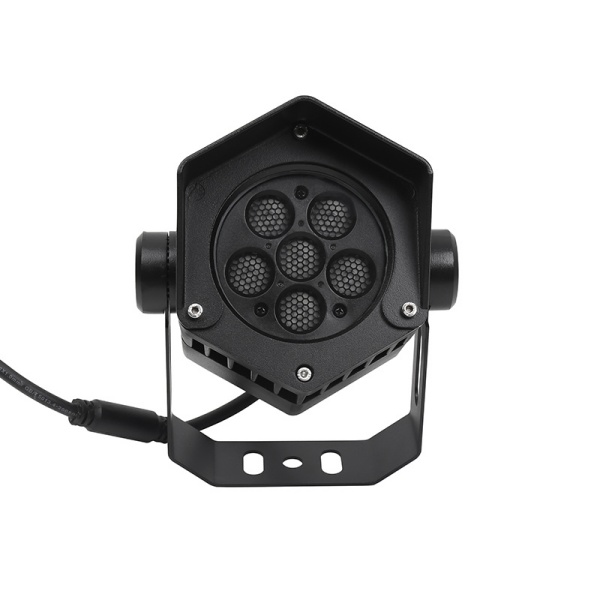
Honeycomb Louvers: Installed inside the fixture to restrict stray side-light.
Snoots & Visors (Barn Doors): Custom-shaped external shields that cut off light spill at precise architectural boundaries.
3. Adopt Top-Down (Downlighting) Projection
Whenever structural conditions permit, mount luminaires higher up and aim them downward onto the facade rather than up toward the sky. Top-down lighting drastically reduces atmospheric skyglow.
4. Smart Scheduling & Dimming Controls (DMX512 / RDM)
Landmark illumination does not need to operate at 100% intensity all night long.
Peak Tourism Hours (19:00 – 22:00): Full aesthetic lighting effect.
Late Night Hours (After 22:00): Automatically dim overall brightness by 50% or switch to subtle accent modes via programmed DMX512 controllers.
5. Control Color Temperature & Spectral Output
High-correlated color temperatures (CCT) above 5000K contain high proportions of blue light, which scatters easily in the atmosphere and exacerbates skyglow.
Recommended CCT for Landmarks: Use warm white (2700K-3000K) or warm gold light for traditional masonry and heritage sites. Warm spectra produce less atmospheric scatter and preserve night ecosystems.
Comparison: Anti-Pollution vs. Traditional Lighting Setup
| Feature / Metric | Traditional Facade Lighting | Eco-Friendly Anti-Pollution Design |
| Beam Angle | Wide Symmetric ($60^\circ - 120^\circ$) | Narrow / Asymmetric (3°15° 15*45°) |
| Optical Shielding | Bare Lens / Standard Glass | Honeycomb Louvers, Visors, Anti-Glare Cut-offs |
| Aiming Angle | Upward Ground-to-Sky Uplighting | Top-Down or Strict Target-Focused Angles |
| Control Protocol | Basic On/Off Timer | DMX512 / RDM Dynamic Dimming & Scheduling |
| Color Temperature | Cool White (5000K-6500K) | Warm White / Gold (2700K-3000K) |
Frequently Asked Questions (FAQ)
Q1: How does precise optical control save energy in landmark lighting projects?
Answer: By using narrow beam angles and anti-glare louvers, up to 95% of the emitted light is delivered directly onto the building surface rather than being wasted into the sky. This allows engineers to achieve higher lux levels on the target using lower wattage LED fixtures.
Q2: What international standards regulate outdoor light pollution?
Answer: The Commission Internationale de l'Éclairage (CIE) and the International Dark-Sky Association (IDA) provide recognized guidelines classifying environmental lighting zones (E1 to E4). Landmark projects in urban areas (Zone E3/E4) must limit upward light ratio (ULR) to under 5%–15%.
Q3: Can dynamic RGBW LED lights comply with dark-sky regulations?
Answer: Yes, provided they are fitted with narrow-beam lenses, directional visors, and programmed to reduce intensity or turn off dynamic effects during off-peak night hours.
Sustainable Landmark Lighting Solutions by Always Lighting
At Always Lighting, we engineer customized outdoor architectural fixtures equipped with narrow optics, anti-glare louvers, and IP67 weather resistance designed to meet strict dark-sky requirements.